Screenwriting Craft · analysis
10 Screenplay Mistakes That Make Readers Stop Turning Pages
Spot 10 screenplay mistakes that drain momentum, lose readers, and trigger a pass—plus the smartest way to decide what to rewrite first.
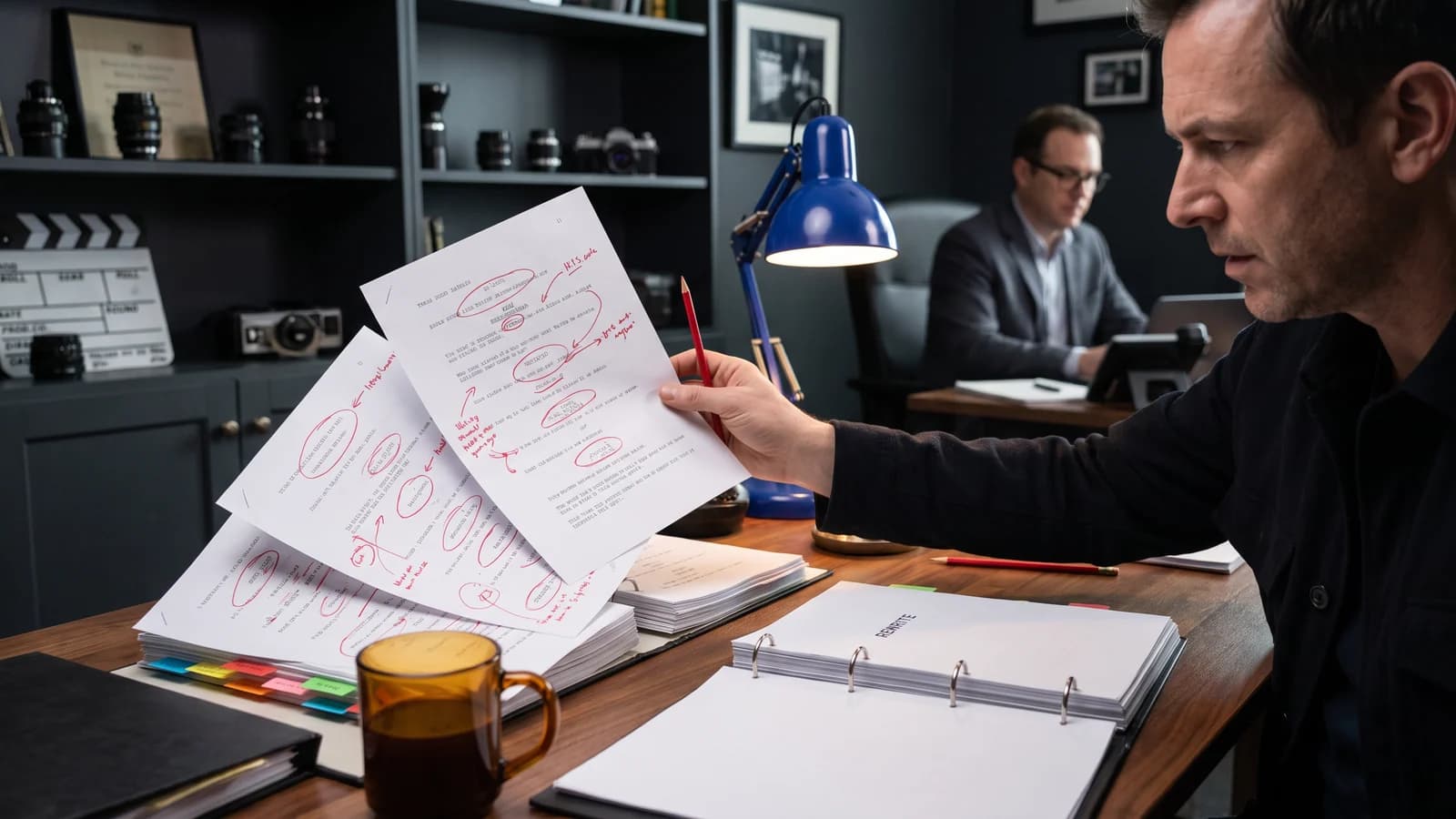
You know the moment. You type FADE OUT, lean back, and briefly become convinced you have written Chinatown with better jokes. Then you reread page four and discover your hero has spent three scenes making coffee.
Welcome to rewriting.
Most screenplay mistakes are not proof that you cannot write. They are signs that you have been living inside the draft too long. The good news is that the problems readers notice fastest are often the ones you can fix fastest.
1. The story is still warming up
If the first ten pages are mostly introductions, errands, weather and tasteful shots of the neighborhood, the reader is waiting for the movie to begin.
You do not need an explosion on page one. You do need a question, disturbance or tension that makes the next page feel necessary. Ask a brutal little question: What changes if I start the story five pages later? If the answer is “not much,” reach for the scissors.
2. Your protagonist is riding in the passenger seat
A protagonist can be confused, frightened or spectacularly wrong. What they cannot be for long is inert.
Give them a want, then force them to make choices in pursuit of it. A bad choice is still dramatic. A character waiting for the plot to deliver instructions is not.
3. Everyone says exactly what they mean
Real people dodge, tease, deflect and weaponize the phrase “I’m fine.” Screenplay characters should be allowed the same pleasure.
Instead of having a character announce the emotion, let the scene create it. A wife carefully folding her husband’s shirts into a suitcase can say more than a speech beginning, “I’m angry that you betrayed me.” Let the audience do a little work. They enjoy it.
4. The action lines ate the screenplay
Dense gray paragraphs make a script feel slower before the reader has absorbed a word. Screenplay prose should move like the camera’s attention: quick, selective and visual.
Cut internal thoughts we cannot see. Break action into readable beats. Keep the telling detail and lose the furniture catalog. “The apartment is spotless except for one bloody sneaker” gives us more movie than six lines of décor.
5. The stakes are technically present but emotionally absent
“The company may lose the contract” is information. “She will lose the family business her mother built from nothing” is a stake.
Make failure personal, specific and increasingly difficult to undo. The audience does not need the fate of the world in every movie. It needs to understand why this outcome would wreck this person.

6. The formatting keeps waving for attention
Formatting should be invisible. When margins wander, scene headings improvise and fonts multiply, the reader stops watching the movie and starts noticing the document.
Use professional screenwriting software. Learn the standard conventions. Then stop fussing with them and return to the story. The Academy’s screenwriting resource collection and the Writers Guild Foundation’s screenplay primers are useful craft references when you need a reality check. Proper format will not rescue a weak script, but distracting format can make a good one feel less ready.
7. The genre keeps changing outfits
A thriller can be funny. A comedy can break your heart. The problem arrives when the movie seems unsure what promise it made.
Decide what experience sits at the center. If it is horror, tension and dread should survive the jokes. If it is romance, the relationship should remain the engine even when the plot gets busy. Tonal variety is delicious; tonal amnesia is not.
8. Supporting characters exist only to deliver snacks and exposition
The best supporting characters appear to have walked in from movies of their own. They want things. They keep secrets. They occasionally refuse to help the protagonist because they have plans for Tuesday.
Give each important character one desire that does not belong to the hero. That single adjustment can turn a plot device into a person—and create conflict for free.
9. Coincidence keeps doing the hero’s job
Coincidence can create trouble. It is much less satisfying when it solves trouble.
Plant skills, objects and relationships before the climax needs them. If your hero flies a helicopter in Act Three, give us a reason to believe they can do that before everyone is dangling over a volcano. Setups do not have to be loud. They just have to exist.
10. The ending sprints for the parking lot
Writers spend months repairing the middle, arrive at page 95 exhausted and suddenly resolve three relationships, a murder and a custody battle before lunch.
Your climax is the bill coming due. Give the central choice room to hurt. Then allow enough resolution for us to see what the choice changed. The ending does not need to be long, but it should feel earned rather than evacuated.
A quick self-check before you send the script out
Try this without opening a coverage report:
- Read the first ten pages aloud. Where does your attention drift?
- Write what the protagonist wants in one sentence. Can you track their pursuit scene by scene?
- Circle every paragraph longer than four lines. Does each one deserve the space?
- List the five biggest turns. Does each result from a choice, not a rescue?
- Summarize the ending as a character decision. Is it the hardest choice the story could demand?
Then put the screenplay away for a few days and run the list again. Distance is the cheapest script consultant in town.
Find the mistake with the biggest shadow
Do not attack all ten problems at once. Choose the issue with the largest downstream effect. A passive protagonist can cause weak stakes, slow pacing and convenient plotting, so fixing agency may repair half the script in one pass.
When you are too close to tell which problem is driving the others, bring in a fresh set of eyes. A trusted peer can tell you how the read feels. AI-powered screenplay analysis can scan structure, character, and pacing without making you wait for everyone in your writing group to finish their own drafts first.
The goal is not a screenplay with no imperfections. That creature does not exist. The goal is a draft whose strengths are so alive that the reader keeps turning pages before remembering they planned to make dinner.
Want to know which of these ten problems is stealing the most energy from your story? Create a free account, use the welcome credit, and run a Quick Analysis. You will have a clearer first target for the rewrite—and no excuse to spend tomorrow adjusting the title-page font.
Sources
- Screenwriting Resources — Academy of Motion Picture Arts and SciencesAccessed 2026-07-17
- Screenplay Primers — Writers Guild FoundationAccessed 2026-07-17
- Writing Your Screenplay: Page One — Writers Guild FoundationAccessed 2026-07-17