Industry & Careers · platform comparison
The Black List vs. Script Coverage: Are You Buying Notes or a Shot at Visibility?
The Black List and script coverage solve different problems. Compare notes, evaluation, visibility, cost, and the smartest order for using each.

The Black List and script coverage services both ask someone to read your screenplay and write things about it. That is roughly where the similarity ends.
One product is built around evaluation and industry visibility. The other is usually built around private development. Mixing them up is like buying a headshot session and complaining that nobody fixed your second act.
The difference in one table
| Question | The Black List | Private script coverage |
|---|---|---|
| Main job | Evaluate and surface material | Diagnose or develop the draft |
| Audience | Writer plus potential industry discoverers | Usually the writer |
| Reader | Vetted human readers | Human, AI or hybrid by provider |
| Visibility | Central to the platform | Usually none |
| Programs and labs | May be part of the ecosystem | Usually not included |
| Note depth | Bounded evaluation | Ranges from scorecard to deep development |
If you remember only one thing, remember this: coverage buys help with the screenplay; The Black List buys an evaluation inside a discovery system.
What The Black List is designed to do
The Black List describes its platform as a way to raise exceptional work’s visibility among thousands of industry professionals. Writers host projects, purchase evaluations and may become more discoverable through scores, lists and opportunities.
That network is the distinctive product. A private consultant may adore your script and give transformative notes, but their enthusiasm does not automatically place the project in an industry-facing database.
The reverse is also true. A Black List evaluation may be useful without functioning as a rewrite workshop. Its job is to assess the screenplay within a competitive environment, not hold your hand through version 14.
Who reads—and what AI does not do there
The Black List says its evaluations are written by humans and prohibits readers from entering writers’ work into large language models. Its reader qualifications describe relevant professional experience and a selective application process.
AI coverage has a different résumé. It wins on speed, price and repeatability. It can produce broad diagnostics during active revision. It cannot reproduce an individual reader’s industry context or create The Black List’s visibility network.
That is not a defect. It is a different job description.
Why useful comments can arrive with a disappointing score
A development reader asks, “How can this draft become more fully itself?” A gatekeeping evaluation also asks, “How strongly does this compete right now?”
Those questions overlap, but they do not land on the same number. A reader may see real promise, offer sharp observations and still decide the execution is not competitive enough for a high overall evaluation. A commercial premise may score well while carrying craft issues a consultant would spend ten pages unpacking.
Do not judge development notes solely by a score, and do not judge a discovery platform solely by the number of rewrite suggestions.
When coverage should come first
If you already know the script has an Act Two fog bank, a passive protagonist or an ending held together by hopeful punctuation, it is early for a visibility experiment.
Private coverage lets you improve the work without treating every draft as a public audition. Low-cost AI script coverage is useful during structural iteration. A human consultant becomes valuable when the questions depend on taste, culture, genre expertise or a conversation about your intent.
The goal is to arrive at evaluation after you have stopped paying premium prices to discover fixable draft problems.
When The Black List makes more sense
Consider The Black List when:
- the screenplay is polished enough to represent you;
- you want an external professional evaluation, not open-ended coaching;
- industry visibility is a real objective;
- a platform program or lab fits the project;
- you understand the total cost and can set a stopping rule.
The program documentation explains how project status and evaluations can relate to opportunities. None of that guarantees discovery, representation or a sale. It creates a route, not a teleportation device.
Avoid the score-chasing treadmill
Before buying an evaluation, decide what outcome would make the experiment useful. A score? Written reaction? Eligibility for a specific opportunity? A limited period of hosting?
Without a plan, it is easy to purchase another evaluation because the last number felt almost right. Scores are subjective. Repeated spending does not necessarily produce a clearer revision strategy.
If a result exposes a problem, step off the platform and solve the problem. The screenplay does not improve because the dashboard refreshed.
The smartest order of operations
For many writers, the sequence looks like this:
- Finish and self-edit the draft.
- Use peers or affordable diagnostics while the story is still moving.
- Bring in targeted human feedback for the hard subjective questions.
- Enter an evaluation and discovery ecosystem when the script is ready to travel without you.
Not every project needs every step. The point is to stop asking one product to perform another product’s miracle.
The verdict: development first, visibility second
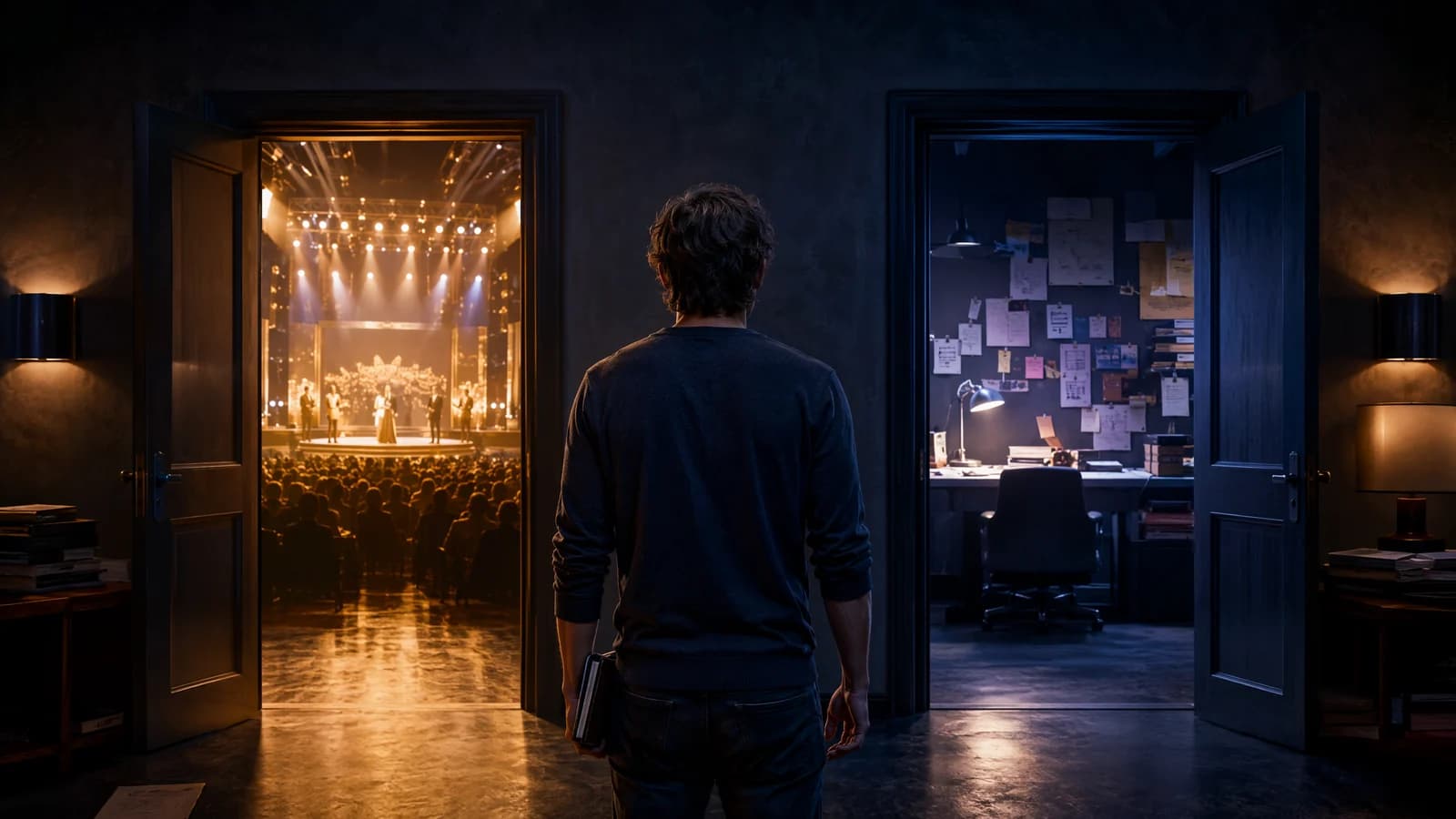
Choose script coverage when you want a better draft. Choose The Black List when you want professional evaluation connected to a visibility ecosystem. Use both only if both outcomes matter—and use them in that order unless you enjoy paying discovery prices for rewrite notes.
The screenplay may receive comments either way. What you are buying is different: development on one side, exposure plus evaluation on the other. Once that distinction is clear, the “Black List vs. script coverage” debate becomes a much easier decision.
If you are not sure the draft is ready to travel without you, find out before you pay for the audition. Create a free account, use the welcome credit for a Quick Analysis, and check the broad structure, character, and pacing signals first. Fixing a visible problem now is far cheaper than paying a platform to confirm it later.
Sources
- About the Black List platform — The Black ListAccessed 2026-07-16
- Black List reader qualifications — The Black ListAccessed 2026-07-16
- Black List AI evaluation policy — The Black ListAccessed 2026-07-16
- Black List programs and labs — The Black ListAccessed 2026-07-16