Industry & Careers · filmmaker craft profile
Christopher Nolan’s Screenwriting Method: 7 Lessons Worth Stealing
Learn Christopher Nolan’s screenwriting method through seven practical lessons on point of view, nonlinear structure, emotion, rules, and visual storytelling.
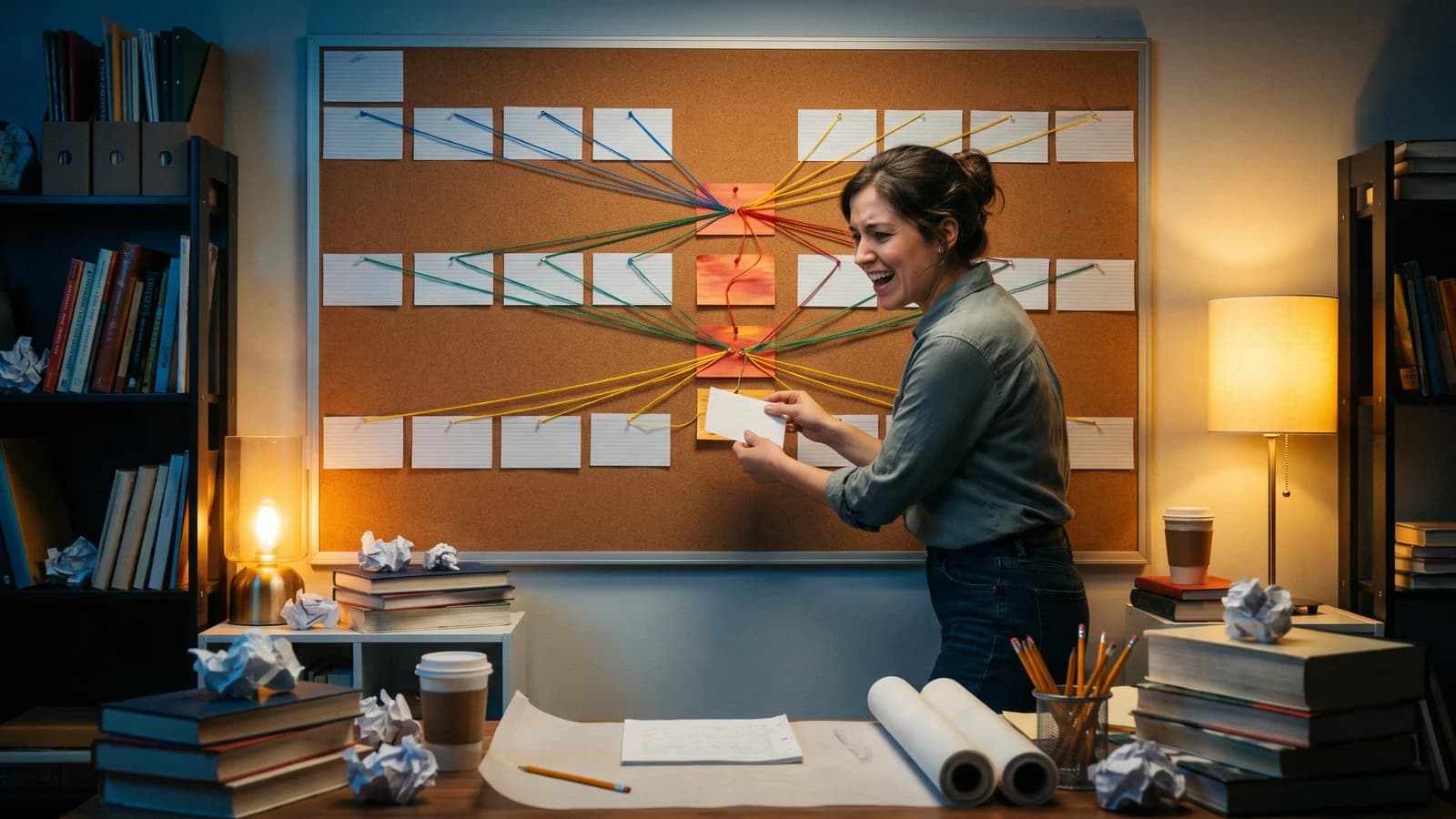
Christopher Nolan has spent a career making very expensive movies behave like locked rooms. Time runs backward. Dreams stack inside dreams. Three clocks tick at different speeds. A physicist remembers his life in color while another man’s account advances in black and white.
The obvious screenwriting lesson is: buy more index cards.
It is also the wrong one.
Here is the useful answer: Christopher Nolan’s screenwriting method starts with the audience’s experience, then chooses a structure that makes us feel the protagonist’s problem from the inside. The puzzle is not decoration. Point of view, time, rules, images and emotion are designed to squeeze the viewer into one specific dramatic experience.
That distinction matters. Copy the backward chronology and you have a trick. Copy the reasoning behind it and you have a method.
The timing is good for a closer look. Nolan’s The Odyssey opened July 17, 2026, and launched with an estimated $264.1 million worldwide, according to the Associated Press. A nearly 3,000-year-old story had become the week’s biggest pop-culture event. Not because audiences were assigned Homer over the summer. Because a filmmaker made an ancient promise feel immediate.
So let’s leave the imitation waistcoat on the hanger and steal the parts of the process that can actually improve your next draft.
The Christopher Nolan screenwriting method in seven moves
In practical terms, Nolan’s recurring approach looks like this:
- Choose the experience you want the audience to inhabit.
- Make structure express the protagonist’s condition.
- Turn rules into pressure, not homework.
- Protect a simple emotional engine beneath the machinery.
- Write for images, action and rhythm—not dialogue alone.
- Break screenplay convention only to sharpen the read.
- Deliver the most involving version of the story’s promise.
None of these requires a $250 million budget, an IMAX camera or a hallway that rotates. They do require an answer to a harder question than “Wouldn’t it be cool if?”
1. Start inside the experience, not above the plot
Writers often begin with an aerial view:
This is a story about memory, guilt and the nature of truth.
Fine. That is a panel discussion. Where is the movie?
In a July 2026 60 Minutes interview, Nolan described trying to find a point of view from inside the film—to put the audience in the race or maze with the characters. When writing, he said, he imagines experiencing the film as an audience member.
That is a wonderfully physical test. Do not ask only what the story means. Ask what it feels like to receive each piece of it.
For Memento, the central problem was not merely that Leonard cannot form new memories. The screenwriting opportunity was to deny the audience the information Leonard lacks. Nolan told BAFTA that he wanted to make the adaptation of Jonathan Nolan’s story subjective. Reverse chronology gave the viewer the same missing “just before” that torments the protagonist.
Try the test on a more ordinary premise:
A chef hides early-onset dementia while trying to earn her restaurant’s first star.
The aerial version is about identity, ambition and loss. The inside-the-film version asks:
- What information does she lose that the audience should lose with her?
- When should the audience know more than the kitchen staff?
- Which repeated task becomes terrifying because she can no longer trust herself?
- What does success feel like if she cannot remember achieving it?
Now structure, suspense and character are arriving at the same party.
Steal this: finish the sentence, “The audience should experience this story as if they are…” If the answer is “watching events happen,” keep digging.
2. Make the structure behave like the story problem
Nonlinear structure is not automatically sophisticated. Sometimes it is a screenplay spilling its handbag on the floor.
Nolan’s strongest structural choices behave like the subject:
- Memento withholds immediate history from a man who cannot retain it.
- Inception nests time inside levels of dreaming.
- Dunkirk compresses three perspectives operating over different durations.
- Oppenheimer separates competing experiences through chronology, point of view and visual form.
In his BAFTA conversation, Nolan explained that reverse chronology clicked when he found a conceptual way for Memento’s form to mimic Leonard’s condition. In a later Sight and Sound interview, he pushed back on the assumption that stories must move cleanly from beginning to end; literature has been rearranging time for centuries.
The key is not permission to shuffle. The key is causality.
Before breaking chronology, write the benefit in plain language:
| Structural choice | What the audience gains |
|---|---|
| Start near the ending | A question that changes how earlier events are read |
| Alternate timelines | Meaning created by contrast or convergence |
| Repeat an event | New information, allegiance or emotional context |
| Withhold a time jump | Temporary identification with a confused character |
| Reverse a sequence | Consequences arrive before their causes |
If the benefit is “it seems more cinematic,” return the cards to chronological order. A rearranged screenplay should create pressure, irony or identification that the straight version cannot.
Steal this: build the chronological version first. Then move only the pieces whose new position changes the audience’s experience.
3. Turn rules into pressure, not homework
The dream architecture in Inception is elaborate: nested levels, time dilation, kicks, projections, limbo, totems. Yet the rules are not there to win a wiki page. They keep making Cobb’s job harder.
That distinction separates a dramatic system from lore.
Nolan told RTÉ that he developed Inception over roughly a decade and examined his own experience of dreaming to discover what kind of rule set might emerge. He did not begin with a glossary. He began with a familiar human experience and pushed it until it could produce choices, danger and surprise.
For every rule in your screenplay, ask:
- Who wants to exploit it?
- Who is trapped by it?
- What choice becomes harder because it exists?
- How can the rule fail at the worst possible moment?
- Can the audience understand it through action?
Suppose your sci-fi drama allows people to send one 30-second message to their younger selves. The weak draft spends six pages explaining the machine. The dramatic draft gives a grieving father one message, then reveals that his daughter has already received something from him.
The rule just became a relationship.
Steal this: delete any rule that does not alter behavior. Convert every surviving rule into a source of temptation, cost or collision.
4. Hide a simple emotional engine under the clockwork
This is the part missed by every parody with twelve timelines and a bass drop.
The mechanism may be complex. The emotional question should be brutally legible.
Can Cobb let go of the version of Mal he carries? Can Bruce resist becoming the vengeance he fights? Can Cooper accept the time his mission steals from his children? Can Oppenheimer live with what his brilliance helped unleash?
You do not need to reduce a movie to greeting-card wisdom. You do need an emotional line the audience can hold while chronology does gymnastics nearby.
With Inception, Nolan’s long development period was not simply an exercise in perfecting dream rules. The RTÉ interview describes years of living with the concept before the finished screenplay. The eventual heist works because every layer pushes Cobb toward the same private wound. Without that, the kicks are a handsome scheduling problem.
Here is a useful two-column outline:
| Plot mechanism | Emotional consequence |
|---|---|
| The plan requires the hero to lie | The lie repeats the betrayal they regret |
| Time moves differently in two locations | A relationship ages unevenly |
| The team must split up | The hero loses the person who challenges them |
| The antagonist controls the evidence | The hero must choose trust without proof |
If the right column is empty, the machinery is not attached to a person yet.
5. Write images and actions the reader cannot skim
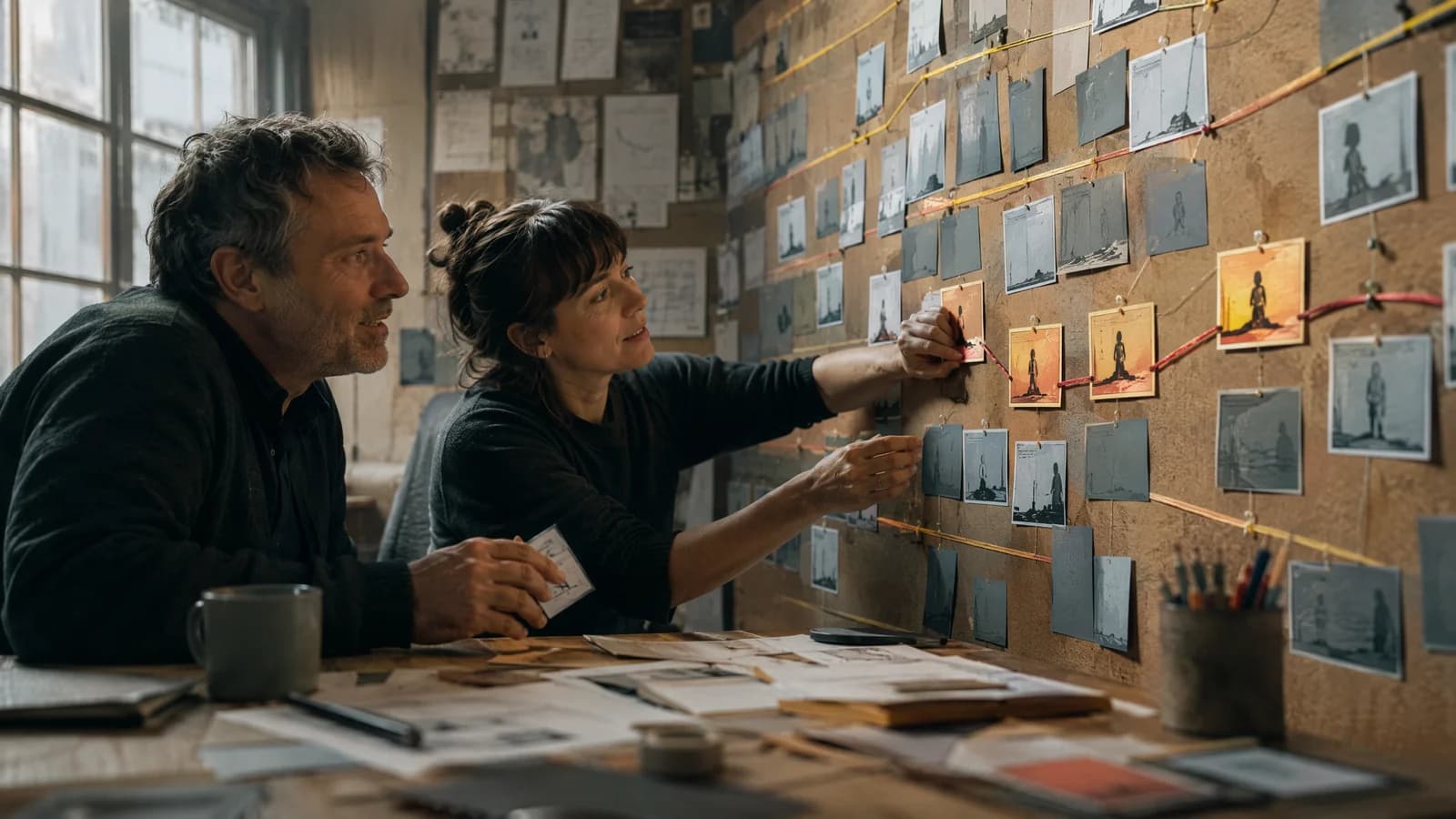
Nolan’s films are discussed as idea machines, but they are unusually physical. A spinning top wobbles. A truck flips. Water enters a grounded boat. A hand reaches through time toward a bookshelf. Theory keeps becoming behavior.
In the BAFTA Life in Pictures conversation, Nolan noted that readers moving quickly through scripts tend to favor dialogue and skip dense description. His response on Dunkirk was not to write louder speeches. It was to depend more deeply on what the screenplay’s action carried.
This does not mean action paragraphs should become technical blueprints. It means the page needs visible decisions.
Compare:
Lena feels that her marriage may be ending.
with:
Lena removes her wedding ring to knead the dough. When the timer rings, she puts it into her apron instead of back on her finger.
The second version gives an actor behavior, a director an image, an editor a beat and the audience a question. Nobody has to announce the theme near a window.
Run a dialogue blackout on one important scene. Cover the spoken lines and read only the scene headings and action. Can you still track who has power, what changes and where the emotional turn lands?
If not, do not add camera directions to fake movement. Give the characters physical business that exposes intention.
Steal this: replace one abstract emotional sentence per scene with a specific action, object, spatial change or withheld response.
6. Break screenplay convention for a precise reason
Nolan wrote the subjective portions of Oppenheimer in the first person. That is the sort of detail that can send screenwriters racing to format an entire spec as “I enter the room.”
Take a breath.
In his KCRW interview, Nolan explained that the first-person approach supported the film’s commitment to Oppenheimer’s eyes and experience. The convention break had one job: keep writer, actor and eventual audience pressed against the protagonist’s perspective.
That does not make first-person action universally better. It makes it appropriate to that formal design.
Before breaking a screenplay convention, pass three tests:
- The purpose test: Can you explain the dramatic benefit in one sentence?
- The reader test: Does the choice become intuitive within a page?
- The production test: Does it clarify the intended movie for collaborators?
If the experiment creates friction without adding meaning, it is not bold. It is admin.
The same applies to colored text, unusual page layouts, repeated slug lines, fractured scene numbers or giant blocks of white space. A spec screenplay can bend. It should not make the reader perform unpaid archaeology.
Steal this: break one rule only after you can name the problem the break solves. Then make the new pattern consistent.
7. Deliver the boldest version of the story’s promise
Nolan’s method is not all restraint and elegantly organized stationery. It is also escalation.
On 60 Minutes, he described pursuing the “most extreme version” of a story. For The Odyssey, that meant imagining the audience inside the Trojan Horse and on the deck of Odysseus’s ship—not politely observing myth from a safe museum distance.
Yet scale is not just acreage. The Associated Press reported that Nolan approached the ancient poem through its earthy sensibility, resisting the elevated language and familiar visual shorthand often used for antiquity. The grand promise and the tactile human approach are working together.
Your screenplay’s extreme version might cost almost nothing:
- A breakup drama told entirely during the couple’s last shift at a 24-hour pharmacy.
- A courtroom thriller where the defendant refuses the defense that would save her.
- A ghost story in which the ghost is the only witness the grieving hero does not believe.
- A comedy about a compulsive peacemaker forced to organize two rival funerals in the same room.
Each premise makes a clean promise. The extreme version does not add explosions. It removes the cautious escape route.
Steal this: identify the expectation embedded in your premise, then find the version that fulfills it with the most pressure, specificity and emotional consequence.
A Nolan-inspired worksheet for your own screenplay
Use this before opening a fresh pack of index cards:
| Question | What it controls | Warning sign |
|---|---|---|
| Whose experience traps the audience inside the story? | Point of view | Every character knows the same things |
| What should the viewer feel before they understand? | Suspense and revelation | Exposition arrives before curiosity |
| Which formal choice behaves like the central problem? | Structure | Scenes are shuffled only to hide a thin plot |
| What simple emotional question survives every timeline? | Character | The climax resolves mechanics but not feeling |
| Which rules force painful choices? | Worldbuilding | Rules exist only to be explained |
| What can be understood without dialogue? | Visual storytelling | Characters repeatedly state their emotions |
| What is the boldest honest version of the premise? | Promise | The script backs away from its own hook |
Answer in one sentence per row. If you need a paragraph, the decision may not be made yet.
Then create two outlines:
- The truth outline: everything in chronological order, including what every major character knows.
- The audience outline: the order in which information creates the strongest identification, tension and payoff.
The gap between those outlines is where nonlinear storytelling earns its keep.
Copy the method, not the mannerisms
You do not need a dead spouse in the backstory, a ticking watch on the soundtrack or a protagonist named after a famous physicist. You need a governing dramatic idea.
That is the portable lesson in Christopher Nolan’s writing process: form follows experience. The order of scenes, the rules of the world, the density of action and even the grammar of the screenplay are all available—but each choice must pull the audience further inside the story.
If you are testing a nonlinear draft, first make sure the foundation is not using complexity to hide familiar screenplay mistakes. Write the straight version of the premise with the logline method, then check that your screenplay format makes the experiment easier—not harder—to read.
Finally, compare the structure you intended with the one actually visible on the page. AI-powered screenplay analysis can help flag pacing shifts, passive stretches and character arcs across a full draft while you remain the person making every creative decision.
Create a free account and your one welcome credit can be used for one free Quick Analysis. Use it as a structural stress test: if the report cannot identify the emotional engine beneath the timelines, a human reader may be wrestling with the same maze.
Make the movie complicated if it needs to be. Make your reason beautifully simple.
Sources
- The Odyssey opens with $264.1 million globally — Associated PressAccessed 2026-07-24
- Christopher Nolan worked to make the most extreme version of a story possible — CBS News / 60 MinutesAccessed 2026-07-24
- Behind Christopher Nolan’s six-country undertaking for The Odyssey — Associated PressAccessed 2026-07-24
- A Life in Pictures: Christopher Nolan — BAFTAAccessed 2026-07-24
- Christopher Nolan: A Showman’s Odyssey — BFI / Sight and SoundAccessed 2026-07-24
- Christopher Nolan on Oppenheimer and writing in the first person — KCRWAccessed 2026-07-24
- Christopher Nolan interview on writing Inception — RTÉAccessed 2026-07-24