Screenwriting Craft · screenwriting craft guide
How to Write a Flashback in a Screenplay Without Losing the Reader
Learn how to write and format a flashback in a screenplay so the time jump is clear, necessary, cinematic, and still moving the present story forward.

Flashbacks have a bad reputation because bad flashbacks deserve one. They arrive carrying a suitcase of exposition, explain the scar, identify the killer and leave the present-day story sitting in a parked car.
A good flashback does the opposite. It changes what the audience understands right now.
To write a flashback in a screenplay, mark the time shift clearly, enter the past at the latest useful moment, dramatize one change in meaning and signal the return to the present. You can put FLASHBACK in the scene heading, use BEGIN FLASHBACK and END FLASHBACK around a sequence, or handle a very brief memory inside the action. There is no single sacred layout. The reader should understand where they are, when they are and why the movie had to go there.
Formatting is the easy part. Earning the trip is the job.
How to write a flashback in a screenplay: the short answer
| If the flashback is... | A clean formatting choice | What it must accomplish |
|---|---|---|
| One full scene | Add `(FLASHBACK)` to the scene heading | Reveal or reframe one consequential event |
| Several scenes | Use `BEGIN FLASHBACK SEQUENCE`, then clear scene headings, then `END FLASHBACK` | Build a coherent mini-sequence with escalation |
| A quick remembered image | Introduce it in action, show the image, then write `BACK TO SCENE` if needed | Land one sharp association without stopping the movie |
| A recurring timeline | Establish the year or era consistently in headings | Let the audience track two storylines without decoding the page |
| A hidden memory or reveal | Describe only what the audience is meant to know | Preserve the surprise without making the read confusing |
The rule beneath every option is clarity. Screenwriter John August’s practical advice is to read the pages as if you did not write them and choose the notation that makes the time shift easiest to follow.
That sounds almost suspiciously sensible. It is also the answer.
First, make the flashback earn its page count
A flashback is not automatically dramatic because the event happened years ago. Past-tense misery is still exposition if nobody makes a choice.
Before formatting anything, finish this sentence:
The audience must see this memory now because it changes ________.
Good answers include:
- how we judge the protagonist’s present decision;
- who holds power in the current scene;
- what an object, line or location means;
- whether we trust a character’s version of events;
- the danger attached to a choice already in motion; or
- the emotional question the audience is carrying forward.
“Because the audience needs the backstory” is not yet an answer. Backstory is information. Drama is information arriving with pressure.
Imagine Mara refuses to enter her late father’s workshop. You could flash back to eight-year-old Mara happily sanding a model boat beside him. Lovely light. Warm dust. Absolutely fatal momentum.
Or you could let present-day Mara find a broken compass, then flash back to the moment her father blamed her brother for breaking it while Mara stayed silent. Now the memory does work. It explains the guilt, alters our judgment and makes opening the workshop door a moral choice.
The current Final Draft overview separates flashbacks into broadly occasional and structural uses and recommends asking what the past scene adds—and whether the story works better without it. That is the right first cut: is this one revealing interruption, or is the movie itself built to move between time periods? Final Draft’s flashback guide treats those as different structural commitments, not different labels for the same trick.
Use the five-second orientation test
The reader should not need a corkboard and red string to discover that the protagonist is suddenly twelve.
Within roughly the first few lines of the flashback, establish three things:
- When are we? Give us a year, an age, a recognizable era or an unmistakable change in circumstance.
- Where are we? Use a normal, filmable scene heading.
- Whose experience organizes the memory? Anchor us to the character, object, sound or action that triggered the move.
You do not need to announce all three with giant labels. Often the scene heading handles time and place while the first action line handles point of view.
INT. MARA'S FATHER'S WORKSHOP - NIGHT (FLASHBACK)

Mara, eight, holds the broken compass behind her back.
Her older brother stands accused across the workbench.
No smoke effect. No rippling screen. No paragraph explaining the emotional architecture. The page simply stops making the reader guess.
How to format a single flashback scene
For one self-contained past scene, add (FLASHBACK) or a specific time marker to an ordinary scene heading.
INT. WORKSHOP - NIGHT (FLASHBACK)

Eight-year-old Mara slips the compass into her pocket.

Her father enters. Sees the empty case.
Then make the return equally clear:
INT. WORKSHOP - NIGHT (PRESENT)

Mara opens her hand. The same compass, still broken.
Final Draft’s June 2026 formatting guide presents both explicit FLASHBACK / END FLASHBACK labels and flashback notation inside scene headings as readable options. The software is not choosing your story grammar for you. It is giving production and the reader an unmistakable signpost.
If the actual year matters, use it consistently:
INT. WORKSHOP - NIGHT (1998)
When you return:
INT. WORKSHOP - NIGHT (PRESENT)
Specific years are useful when the film moves among several periods. If the year carries no story value, “FLASHBACK” may be kinder than asking the audience to subtract dates in the dark.
How to format a flashback sequence
When the memory moves through multiple locations, frame the sequence once and keep the internal geography clean.
BEGIN FLASHBACK SEQUENCE

INT. SCHOOL CORRIDOR - DAY

Mara trails behind her brother, gripping the compass.

EXT. BUS STOP - RAIN

She drops it through a storm drain.

INT. FAMILY KITCHEN - NIGHT

Her brother takes the blame.

END FLASHBACK SEQUENCE

INT. WORKSHOP - NIGHT (PRESENT)
You can also append (FLASHBACK) to every heading. For a long, clearly established past timeline, a year marker may read more naturally. Pick one system, introduce it cleanly and stop decorating it.
The Writers Guild Foundation’s spec-script formatting primer notes that Our Flag Means Death scripts generally mark flashbacks in the scene heading, then add (PRESENT) when returning. It also describes brief flashes introduced with FLASHBACK: and closed with BACK TO THE PRESENT:. That is a useful reminder that house styles vary—even professional scripts solve the same navigation problem in more than one way.
How to format a quick flash or memory fragment
Sometimes the movie needs half a second, not a scene.
A FLASH OF MEMORY:

The compass falling through black water.

BACK TO SCENE

Mara grips the workbench until her knuckles pale.
For a single remembered image, full scene headings can feel like stopping a bicycle to file a flight plan. August’s guide to short cutaways and BACK TO lays out both approaches: use full headings when the change of place needs them, or write the brief cutaway inside action when that is clearer. BACK TO reminds us the original scene never stopped happening.
Use that compressed form for a genuine fragment: a face, a hand releasing a railing, a red taillight disappearing. The moment the memory develops its own location, action and change, give it a proper scene.
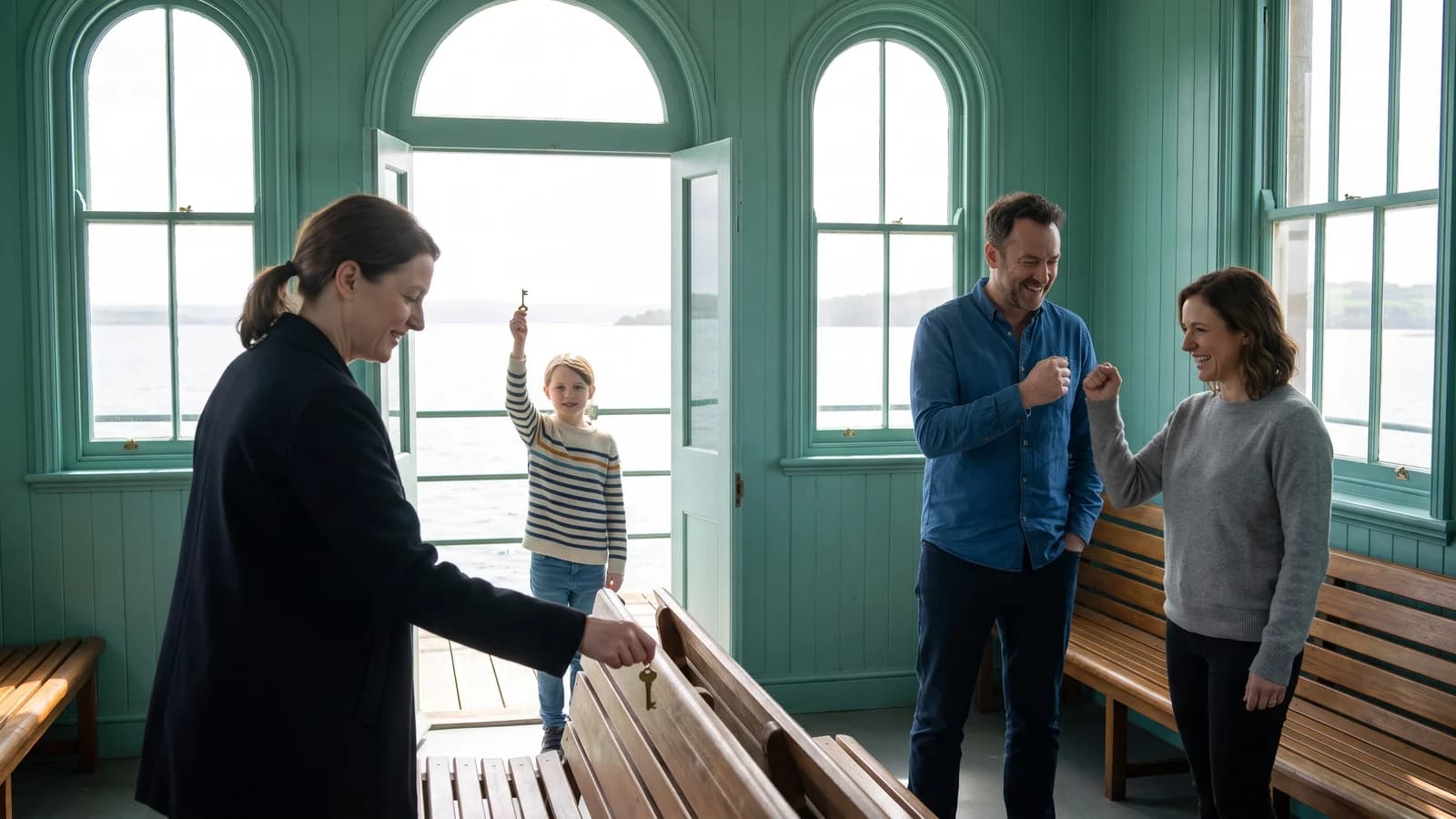
Build a visual bridge into the past
The clumsiest flashback begins because the screenplay has information to deliver. The best one begins because the present has touched a live wire.
Give the cut a bridge the audience can feel:
- Object: Mara turns the broken compass. Cut to the compass new in her father’s hand.
- Sound: A train brake screams. Cut to a childhood kettle shrieking in a silent kitchen.
- Gesture: An adult rubs a burn scar. A younger hand reaches toward the flame.
- Line: “You always let him take the blame.” Cut to the first time she did.
- Location: A hotel ballroom after closing becomes the same room on opening night in 1984.
- Contradiction: A character says, “I never went inside.” Cut to their wet footprints on the floor.
The bridge is not a fancy transition for its own sake. It tells the audience why this memory has arrived at this exact pressure point.
Then build an exit with equal care. Bring an image, sound, gesture or unfinished action back into the present. The movie should return carrying something it did not have before.
If Mara enters the flashback holding the broken compass and returns merely looking sad, the past has illustrated a feeling. If she returns and finally tells her brother she broke it, the past has changed behavior.
That is the standard: memory in, decision out.
Write the past as a scene, not a case file
Once you enter the flashback, the normal demands of screenwriting still apply. Somebody wants something. Somebody or something resists. The power changes.
Do not write:
Mara remembers how her father often favored her and blamed her brother
for things he did not do, which created years of resentment.
That is a psychological report wearing Courier.
Write the behavior: the father asks who opened the compass case; Mara hides the compass; the brother sees her do it; the father punishes him; he chooses not to expose her. Now the past contains a choice by every important character. The audience gets history and a fresh question: why did the brother protect her?
The same discipline in writing a screenplay scene applies here. Enter after the pleasantries. Give the scene a turn. Leave on the consequence.
Do not use the past to rescue a motionless present
Writers sometimes keep leaving the present because the present has nowhere to go.
Every time Mara touches an object, we visit childhood. Every new character triggers an explanatory memory. The flashbacks grow more vivid while present-day Mara waits to receive them. Eventually the audience starts rooting for 1998 because 2026 appears to have misplaced the plot.
The fix is rarely “better transitions.” Give the present-day protagonist a plan, opposition and a ticking consequence. Then a flashback can complicate active drama instead of substituting for it.
Scriptnotes’ 2026 discussion of the related flash-forward fallback warns against borrowing fireworks from later because the chronological opening is too quiet. The same diagnostic applies in reverse. If the most alive part of your movie keeps happening twenty years ago, ask whether the past is actually the main story—or whether the current timeline needs a harder choice.
Try removing the flashback and reading the surrounding present-day scenes together. If nothing breaks except a piece of explanation, you may not need the scene. If a present decision becomes emotionally or causally impossible to understand, the flashback may have earned its place.
Let memory be subjective without becoming vague
A flashback does not have to be courtroom evidence. It can be incomplete, biased or wrong.
But the screenplay must distinguish a character’s unreliable memory from the writer’s unclear staging.
You can make subjectivity legible through:
- details that change when the memory returns;
- an action withheld in the first version and revealed later;
- sound or imagery tied to the remembering character;
- a contradiction between two characters’ recollections; or
- present-day evidence that exposes what the memory omitted.
Do not solve unreliability by fogging every line with “perhaps,” “seems” and “maybe.” Show the version the character believes. When the correction comes, show the precise difference.
This is where flashbacks become more than delivery systems. The audience is not only learning what happened. It is learning how a character has edited what happened in order to survive it.
The flashback repair pass
When a memory scene feels slow, diagnose it in this order.
1. Test necessity
What present-tense decision becomes sharper because we saw the past? If you cannot name it, cut the flashback temporarily.
2. Cut the runway
Start at the accusation, the forbidden touch, the almost-confession or the door already closing. Childhood breakfast before the terrible event is still breakfast.
3. Remove repeated information
If the present scene says Mara betrayed her brother and the flashback shows exactly that, the audience pays twice. Let the present imply and the past complicate—or let the past reveal and the present react.
4. Find the turn
The flashback should change value: trust to betrayal, safety to danger, certainty to doubt, shame to recognition. A memory that begins sad and ends equally sad may be mood, not scene.
5. Strengthen the return
Cut back one beat earlier than feels comfortable. Make the audience complete the emotional arithmetic in the present.
This is also a useful screenplay rewrite strategy: fix the story function before polishing the description of rain on the childhood window.
A flashback checklist for your next draft
Before you keep the scene, ask:
- Can a first-time reader identify the time shift immediately?
- Is the location formatted like a normal, shootable scene?
- Does the flashback contain a choice, conflict or turn?
- Does it reveal more than the dialogue already told us?
- Is it triggered by present dramatic pressure rather than writer convenience?
- Does the exit back to the present read clearly?
- Does something in the present change after we return?
- Could the same effect be achieved faster with behavior, a prop or one line?
- If the film uses several timelines, is the notation consistent?
- If you delete the flashback, does the story lose drama—or only explanation?
Formatting can make a flashback readable. Only consequence makes it necessary.
Make the reader want to return to the present
The secret to a strong flashback is not making the past irresistible. It is making the present so charged that the audience cannot wait to see what the memory changes.
Mark the time jump. Enter late. Dramatize the buried choice. Leave early. Then come back to a character who must do something different.
If you are too close to the draft to tell whether your timeline is elegant or merely understandable to the person who invented it, get an outside read. Create a free AI Script Coverage Pro account, receive one welcome credit, and use it for one free Quick Analysis. Look for continuity gaps, repeated exposition and places where the present-day drive disappears—then make the final judgment yourself.
A flashback should never feel like the movie opening an old filing cabinet. It should feel like the past has just kicked down the door.
Frequently asked questions
How do you indicate a flashback in a screenplay?
Add (FLASHBACK) to the scene heading, place BEGIN FLASHBACK before a sequence, or introduce a very brief remembered image in action. Signal the return with (PRESENT), END FLASHBACK, BACK TO PRESENT or BACK TO SCENE, depending on the structure you chose.
Do you write FLASHBACK in every scene heading?
For one scene, one label is enough. For a sequence with several locations, you can label each heading, frame the whole sequence with beginning and ending markers, or use consistent year markers. Choose the system that makes the timeline clearest.
Should FLASHBACK be bold or capitalized?
Capitalization makes the time shift easy to spot. Bold or underline may help in a particular script, but neither is mandatory. Consistency and immediate comprehension matter more than ornament.
Can a screenplay start with a flashback?
Yes, but ask what counts as the story’s present. If the opening past scene simply becomes the first chronological event, it may be a prologue rather than a flashback. Either way, the opening must create its own dramatic question instead of promising that the interesting movie begins later.
How long should a flashback be?
As long as it keeps changing the story. A memory fragment may last one image; a structural past timeline may occupy half the film. Page count follows function. Cut any approach, explanation or aftermath that does not alter meaning.
Is it bad to use flashbacks in a screenplay?
No. Flashbacks become a problem when they repeat information, interrupt stronger action or repair a passive present-day plot. Used well, they can reveal motive, reverse our judgment and turn buried history into immediate pressure.
Sources
- How to Format a Flashback in a Screenplay — Final DraftAccessed 2026-10-24
- Everything You Need to Know About Flashbacks — Final DraftAccessed 2026-10-24
- Flashbacks and dreams — John AugustAccessed 2026-10-24
- When you're not really cutting to a new scene — John AugustAccessed 2026-10-24
- Formatting Your Spec Script, a Primer: Part 22 — Writers Guild FoundationAccessed 2026-10-24
- Scriptnotes, Episode 735: The Flashforward Fallback, Transcript — John AugustAccessed 2026-10-24