Screenwriting Craft · guide
How to Write a Scene in a Screenplay That Changes the Story
Learn how to write a scene in a screenplay with a practical method for goals, conflict, turns, visual action, pacing, and stronger endings.
Most weak scenes are not disasters. That would be easier.
They are perfectly respectable rooms where characters exchange useful information, make reasonable points and leave with the story in exactly the same condition they found it.
The formatting is correct. The dialogue is competent. Nothing is technically broken. Nothing is alive, either.
To write a scene in a screenplay, give someone an immediate objective, create resistance that forces a choice, express the conflict through visible behavior and end on a turn that changes the next scene. Start as late as the audience can still understand the pressure. Leave as soon as the change lands. If nothing meaningful becomes harder, clearer, riskier or newly possible, you probably have a conversation—not yet a scene.
That is the short answer. Now let us put it on its feet.
Screenplay scene structure in one glance
A useful scene can be planned with five moving parts:
| Part | The question to answer | Weak answer | Playable answer |
|---|---|---|---|
| Purpose | Why must this scene exist? | “They discuss the debt” | “Mara must get Luis to delay collection” |
| Pressure | Why is this difficult now? | “Luis is annoyed” | “Luis needs the money before the shop closes” |
| Tactic | What does the character actually do? | “Mara explains” | “Mara offers the one possession Luis values” |
| Turn | What changes before the cut? | “They finish talking” | “Luis agrees—then reveals the debt is not his” |
| Exit | What question pulls us forward? | “Mara leaves” | “Who has been threatening Luis?” |
Call this the scene engine. Purpose gives the scene direction. Pressure keeps it from becoming a memo. Tactics make character visible. The turn changes the dramatic weather. The exit converts that change into momentum.
Not every scene needs a screaming match, a secret sibling or a vehicle through the wall. A quiet scene can turn because somebody stops pretending, accepts a glass of water, deletes a voicemail or notices that the second toothbrush is gone. The size of the event does not matter as much as the change in meaning.
In a 2026 Scriptnotes conversation about turning beats into scenes, John August and Drew Goddard describe a scene as something with a chosen beginning, middle and end that should leave with different energy than it entered. That last idea is the test: what is different at the cut?
Start with what the scene must accomplish
Before asking what everybody says, write one sentence that begins:
By the end of this scene...
Finish it with a change, not an activity.
- By the end of this scene, the detective trusts the witness less but needs her more.
- By the end of this scene, the bride chooses the lie over the marriage.
- By the end of this scene, the rookie wins the room and loses the captain.
- By the end of this scene, the son realizes his father came to borrow money.
“They talk about the missing cash” is not a change. “Mara persuades Luis to wait until Friday” is better. “Mara gets until Friday by giving Luis the key to her shop” is a scene beginning to take physical form.
Screenwriter John August begins his own scene-writing process by asking what needs to happen and what would be lost if the scene were omitted. That second question is merciless and useful. Remove your scene. Can the scenes on either side still connect with one small adjustment? If so, you may be protecting good lines inside a scene the movie does not need.
Do not throw away the good lines. Steal them from yourself. Move the joke, image or confession into a load-bearing scene where it has consequences.
Give one character a playable objective
Characters may want enormous things across a movie: respect, safety, justice, escape, love, the crown, the shark dead before the tourists arrive.
Inside a scene, the objective gets smaller and more urgent.
Mara does not enter the flower shop wanting “financial security.” She wants Luis to wait four days for his money. She can attempt that in real time. An actor can play it. Another character can resist it.
A strong scene objective is:
- specific: get the key, hide the bruise, keep the child in the room;
- immediate: it can be pursued before the scene ends;
- opposed: another force makes success uncertain; and
- costly: the attempt reveals, risks or sacrifices something.
The objective does not have to be spoken. In fact, it often becomes more interesting when the public reason for the meeting is not the private mission.
Mara says she stopped by to help Luis close the shop. She is actually there to buy time. Luis says he is counting the register. He is actually waiting to see whether Mara will lie again.
Now the scene has two conversations: the one being conducted with words and the one being fought with behavior.
Build conflict from incompatible plans
Conflict is not volume. It is incompatibility.
If Mara wants a delay and Luis wants to preserve the friendship, he can agree immediately. Scene over. To create pressure, give Luis a plan that cannot coexist with hers: he has to deliver the money tonight, he refuses collateral, or he has already promised the shop key to someone else.
Then let both characters be intelligent.
Weak conflict often comes from one person repeating “no” while the other repeats the request more passionately. Strong conflict evolves because tactics change.
- Mara jokes about the debt.
- Luis keeps counting cash.
- Mara offers partial payment.
- Luis closes the register.
- Mara offers the shop key.
- Luis asks why she thinks the key would be hers to give.
Each beat is an action met by a counteraction. The conversation cannot circle because the balance of power keeps moving.
If your scene stalls, do not immediately write sharper insults. Ask what new tactic the losing character tries. Charm can become guilt. Guilt can become trade. Trade can become threat. Threat can collapse into truth.
That escalation is character. Two people with the same objective should not necessarily use the same weapon.
Make the scene visible before making it eloquent
A screenplay is not a transcript with occasional furniture.
The Academy’s screenwriting guide emphasizes that film is a visual medium and that the audience must be able to see the action unfold. That does not mean every emotion requires a smashed glass. It means the scene’s important changes need an observable expression.
Put the characters somewhere that complicates the business.
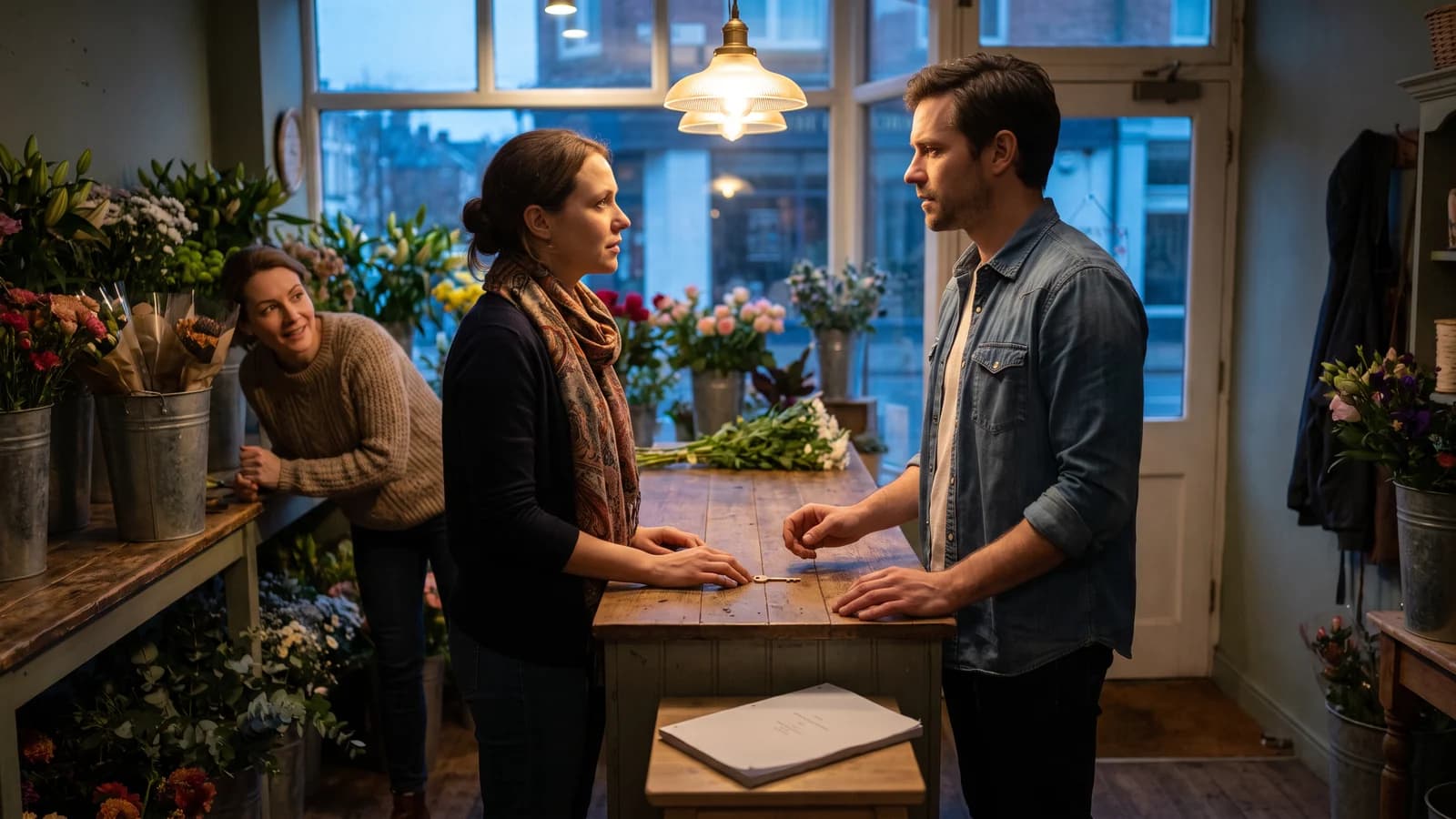
Our fictional debt scene could happen in an empty apartment. Put it in Luis’s flower shop five minutes before a delivery truck arrives, and the location starts writing with you:
- Luis counts the day’s cash while Mara wraps bouquets she has no right to touch.
- Every order bears somebody else’s declaration of love while their friendship frays.
- The delivery buzzer becomes a clock.
- The shop key can move from prop to bargaining chip.
- A refrigerated case gives Luis somewhere to look when he cannot answer.
The setting is not decoration. It provides tasks, obstacles, privacy problems, visual irony and objects characters can use against one another.
Hossein Amini’s BAFTA craft discussion used a dialogue-free sequence from Drive to stress the visual power of screenwriting. You do not need to copy that film’s cool surfaces. Copy the discipline: if the sound failed, would the scene still contain choices an audience could read?
Write behavior that exposes the hidden argument
Subtext becomes dramatically useful when it changes what characters do.
Mara talks about a difficult customer while retying the same ribbon three times. Luis lets her keep helping until she reaches for the register. He slides it closed without looking up.
Nobody has announced, “I no longer trust you around money.” The action delivers it.
The Writers Guild Foundation’s craft framing asks writers to consider how much characters should say, what exposition they reveal and how dialogue gets a story into and out of a scene. The useful question is not “Can I make this line less direct?” It is “What can the character do because saying the truth would cost too much?”
Use a simple two-column pass:
| What the character cannot say | What the audience can watch |
|---|---|
| “I think you stole from me.” | Luis counts the same bills again after Mara touches the register. |
| “I am desperate.” | Mara offers the only key on her ring. |
| “I still want to believe you.” | Luis does not take it. |
This is where our full guide to writing screenplay dialogue picks up. Dialogue should apply pressure, dodge it, disguise it or finally break under it. It should not narrate behavior the audience already understood.

Find the turn before polishing the opening
The turn is the moment the scene becomes a different scene.
It may be a reveal, reversal, decision, arrival, refusal, victory, loss or new interpretation. The important part is that the turn changes what the audience believes will happen next.
For the flower-shop scene, here are five possible turns:
| Turn type | Ending beat | What it launches |
|---|---|---|
| Reversal | Luis gives Mara the money instead | Why is he helping the person who owes him? |
| Revelation | Luis says the debt belongs to Mara’s sister | Mara’s family story becomes unstable |
| Decision | Mara steals the register key | The next scene begins with a crime |
| Refusal | Luis takes her shop key and calls the lender anyway | Mara has paid without buying safety |
| Reinterpretation | Luis already knows Mara never borrowed the money | The whole conversation was a test |
Notice how each ending creates a different movie. Choosing the turn is not decorating the scene. It is choosing the scene’s job in the story.
The best turn is not automatically the biggest surprise. It is the change that feels most specific to these characters and creates the most productive pressure downstream.
If the turn could be swapped into six other screenplays without modification, push deeper. The revelation should not merely be “someone lied.” It should reveal why this person chose this lie against this relationship.
Enter late, but not after the audience needs you
“Enter late, leave early” is excellent advice until it becomes a competition to confuse the reader fastest.
Cut the greetings, parking, coat removal and beverage logistics unless one of them is the battleground. Start at the first moment the scene’s pressure becomes specific.
Too early:
Mara unlocks the flower shop. She turns on the lights. Luis arrives. They discuss traffic. She asks how business has been.
Too late:
Luis throws the shop key into the sink. “You should have told me the debt was hers.”
Useful entry:
Luis counts the last bills in the register. Mara ties a ribbon around a bouquet, too carefully.
“Friday,” she says. “You can hate me properly on Friday.”
We know there is debt, history and a deadline. We do not know everything, but we know what to watch.
August recommends brainstorming several possible beginnings before drafting the full scene. That is valuable because the first acceptable entrance is often an administrative one. Try three:
- the first direct request;
- the first physical action that reveals the conflict; and
- the moment one character realizes the ordinary conversation is a trap.
Then choose the opening that gives the audience orientation and tension in the same move.
Leave on the change, not the cleanup
Writers often find a good ending and then politely escort it out of the building.
Luis reveals the debt belongs to Mara’s sister. Mara absorbs it. She asks what he means. He explains again. She says she should call her sister. Luis agrees. Mara puts on her coat. They say goodbye.
The air leaked out six lines ago.
Cut when the new reality lands:
Luis sets the untouched key beside the register.
“Ask your sister who borrowed it.”
The delivery buzzer sounds.
End scene.
The audience now has emotional impact, a concrete unanswered question and forward motion. The buzzer is not a gimmick; it forces Luis back into ordinary business at the exact moment Mara’s understanding of the debt explodes.
Scene endings also belong to scene beginnings. In their discussion of effective transitions, August and Craig Mazin argue that transitions help propel the story rather than leaving scenes to grind against each other. Consider how the last image, sound, movement or question of one scene creates the first beat of the next.
Mara stares at the key. Cut to her sister forcing a different key into a jammed apartment lock.
No CUT TO: required. The relationship between the images does the work.
Draft the scene in three passes
Trying to invent structure, behavior, dialogue and immaculate action lines at once is a reliable way to spend forty minutes choosing between “looks” and “glances.”
Use three passes instead.
Pass 1: Write the pressure map
Keep it ugly and brief:
- Mara needs until Friday.
- Luis needs payment tonight but will not say why.
- She helps close; he lets her.
- She jokes, offers cash, offers key.
- He tests whether she admits the money was for her sister.
- She does not.
- He reveals he knows.
August calls his own rough version a scribble: a private map that preserves the scene he has imagined without pretending to be finished prose. The point is not to create a miniature screenplay. It is to see whether actions build toward a turn.
Pass 2: Write the playable draft
Now write only what performers and the audience can receive: action, dialogue, sound, space and shifts of attention. Let the characters interrupt your plan if they find a better route, but keep the destination in view.
Céline Sciamma described scenes as central to her process and each scene as a unit of desire. That is a useful antidote to mechanical writing. The pressure map tells you what the movie needs. Desire tells you why you want this particular scene to exist. Find the image, gesture or emotional collision that made you excited to write it in the first place.
Pass 3: Cut the scaffolding
Delete:
- the approach before the pressure starts;
- the explanation after the turn lands;
- repeated tactics wearing new sentences;
- action lines that describe unfilmable intention;
- dialogue that explains the prop, look or silence beside it; and
- any beat included only because “a scene like this usually has one.”
Then check screenplay format so the page disappears and the movie takes over. Format is not the engine, but it should not throw a wrench into it.
Use the scene-change test in your rewrite
After the draft, write two snapshots.
At the beginning: Mara believes Luis is angry about money but can be negotiated with.
At the end: Mara knows Luis has been testing her loyalty and that her sister created the debt.
Now trace what changed:
- information: the borrower’s identity;
- relationship: Luis has moved from creditor to wounded friend;
- power: he knows more than Mara thought;
- plan: buying time is no longer the real problem; and
- emotion: embarrassment becomes betrayal.
You do not need all five. You do need at least one meaningful shift, and the strongest scenes often move several at once.
If your snapshots are identical—“they dislike each other” before and after—try one of three repairs:
- Raise the cost of the objective. What must somebody surrender to get what they want?
- Change the tactic. What choice reveals a side of the character the conversation has hidden?
- Sharpen the turn. What new fact or decision makes the next scene necessary?
This is also a powerful reverse-outline tool. Summarize every scene as “because X happens, Y changes.” A row full of “they discuss...” is not a moral failure. It is a map of where the screenplay has stopped converting information into drama. Our screenplay rewrite guide can help you fix the load-bearing scenes before polishing the decorative ones.
The ten-minute scene checklist
Before moving on, ask:
Purpose
- Can I finish “By the end of this scene...” with a genuine change?
- Would the movie lose something essential if I cut the scene?
- Does the scene create pressure for what follows?
Character
- Who wants something they can pursue right now?
- What is the other character’s incompatible plan?
- Do tactics escalate instead of repeat?
- Does the way each person fights reveal character?
Cinema
- Can the audience read important choices in behavior?
- Is the location creating action, pressure or irony?
- Have I written what matters without micromanaging every shot?
- Does the page let the reader see a movie rather than decode an explanation?
Shape
- Did I enter at the first useful point of pressure?
- Where does the scene turn?
- Is the ending the turn—or the cleanup after it?
- Does the final beat hand energy to the next scene?
If four answers are fuzzy, do not polish the banter. Rebuild the engine.
Write the scene that makes the next scene inevitable
A screenplay is not a necklace of individually impressive scenes. It is a chain reaction.
The scene you are writing should inherit pressure, transform it and send a more dangerous version forward. Give somebody a concrete objective. Make the other person’s intelligent plan incompatible. Turn inner conflict into visible behavior. Change the meaning of the situation. Cut before the characters tidy up the damage.
Then ask the most useful question in scene writing: because this happened, what must happen now?
If the answer is irresistible, the scene works.
When you have a full draft, individual scenes can feel convincing while the larger pattern still drifts. Create a free AI Script Coverage Pro account, receive one welcome credit, and use it for one free Quick Analysis. Use the report to spot where conflict, pacing or character momentum fades across the screenplay—then return to the scenes and make each cut create a reason to keep reading.
Sources
- How to Write a Scene — John AugustAccessed 2026-10-06
- Scriptnotes 728: Beats to Scenes (Drew Goddard) — ScriptnotesAccessed 2026-10-06
- How to Write Effective Scene Transitions — ScriptnotesAccessed 2026-10-06
- Screenwriters' Lecture Series 2019: Céline Sciamma — BAFTAAccessed 2026-10-06
- Hossein Amini: Screenwriters' Lecture — BAFTAAccessed 2026-10-06
- Complete Screen Writing Activities Guide — Academy of Motion Picture Arts and SciencesAccessed 2026-10-06
- Notes on Craft: Dialogue and Scene — Writers Guild FoundationAccessed 2026-10-06