Screenwriting Craft · guide
How to Write Dialogue in a Screenplay That Actors Want to Say
Learn how to write dialogue in a screenplay with sharper objectives, subtext, distinct voices, original examples, and a practical rewrite test.
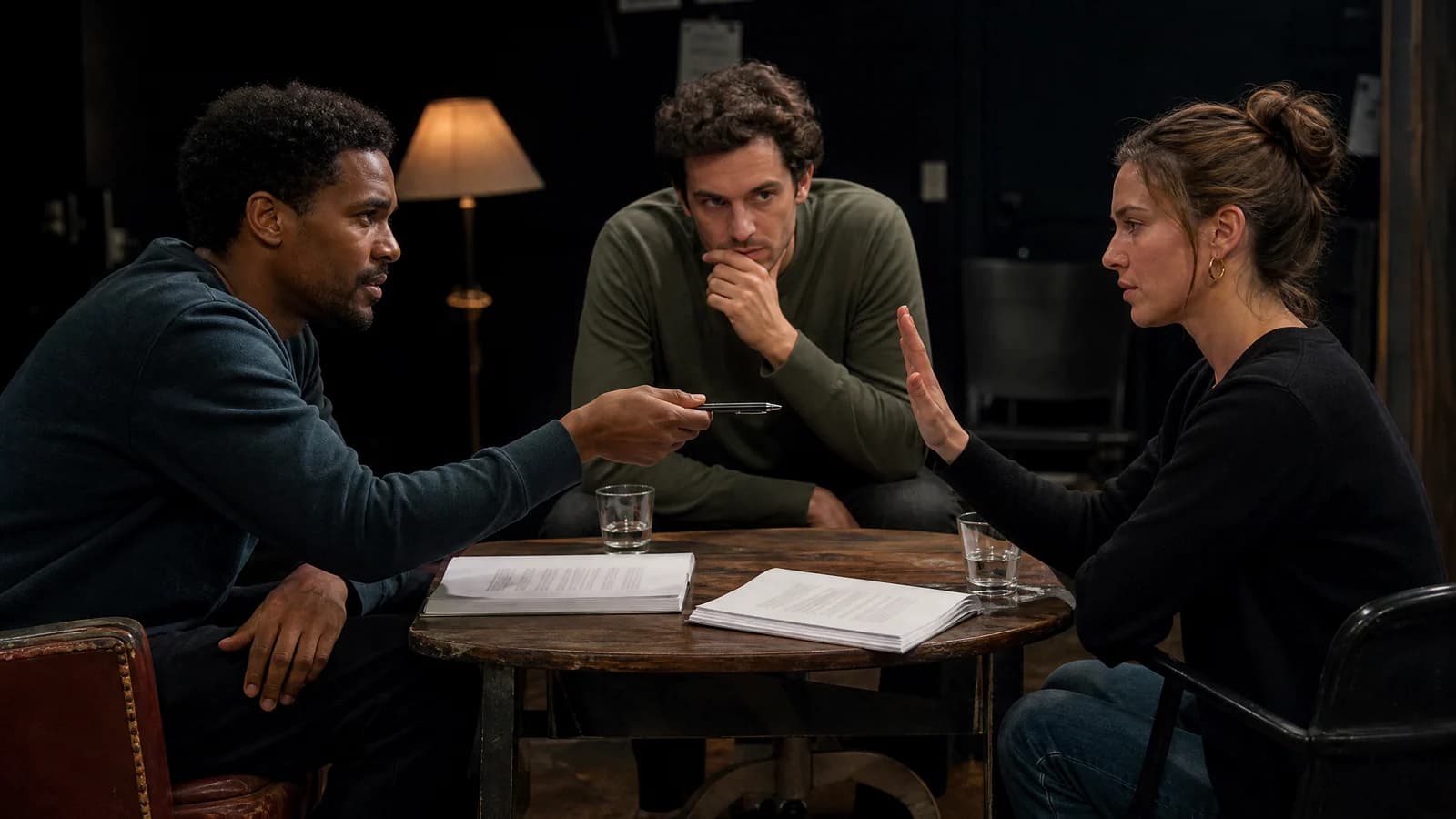
The fastest way to make screenplay dialogue sound fake is to make it sound exactly like a conversation.
Real conversations contain throat-clearing, repetition, weather updates and six-minute detours about parking. Movie conversations have to create the illusion of life while quietly doing the work of drama. They are real speech after a very good editor has removed the furniture.
To write dialogue in a screenplay, give each character a clear objective, put those objectives in conflict and let the characters pursue them indirectly in distinct voices. Cut greetings, repeated information and lines the actor can communicate with behavior. Then read the scene aloud and rewrite every sentence that explains more than it pressures, dodges, reveals or changes.
That is the short answer. The useful answer begins when your two characters sit down for coffee and neither of them is really there for coffee.
Screenplay dialogue is action wearing a sentence
Dialogue is not a delivery chute for plot information. It is something a character does to another person.
A line can charm, threaten, stall, recruit, punish, test, distract, confess or bait. Even “Pass the salt” can be an order, a peace offering or a declaration of war if the last ten minutes have earned it.
The Writers Guild Foundation’s dialogue primer asks writers to define the kind of encounter they are building—a fight, seduction or negotiation—and identify how the characters’ objectives or beliefs oppose each other. That is a much better starting point than “What clever things can they say?”
Before writing a conversation, complete these two sentences:
Character A wants Character B to ______.
Character B wants Character A to ______.
Use verbs that can be played: leave, forgive, invest, confess, stay, surrender, trust. “Talk about their childhood” is a topic. “Make her admit she remembers” is an objective.
Now imagine an original scene. Lena owns a failing neighborhood cinema. Her estranged brother, Owen, has arrived with a contract to sell the building. She wants him to delay the sale. He wants her to sign tonight.
The flat version begins like this:
LENA
I don’t want to sell the cinema because it belonged to Mom, and I’m angry you arranged this without me.
Perfectly clear. Completely dead. Lena has announced the premise, her feelings and the family history like she is reading the scene’s metadata.
The playable version begins with resistance:
LENA
You brought the cheap pen.
OWEN
It works.
LENA
Mom signed my birthday cards with that pen.
OWEN
Mom signed everything with that pen.
Nobody has mentioned the sale. Yet the sale is already in the room, sitting between them and clicking nervously.
Give the scene a public subject and a private argument
Subtext is not vagueness. It is the gap between the conversation people can safely have and the conflict they are actually trying to win.
Lena and Owen can talk about a pen because “You abandoned this place and left me to drown” would trigger the emotional fire alarm. The prop gives them cover. Their word choices do the accusing.
Try a three-layer scene map:
| Layer | Lena | Owen |
|---|---|---|
| Public subject | Which pen to use | Whether the pen works |
| Immediate objective | Delay the signature | Get the contract signed |
| Buried need | Make him prove the family mattered | Escape the guilt of leaving |
Every line should operate on at least two layers. Owen’s “It works” describes the pen, defends the sale and summarizes his worldview. Function matters more than sentiment.
John August and Craig Mazin make a related distinction in their Scriptnotes discussion of dialogue and character voice: a character should speak for their own need in the moment, not merely say what the screenplay needs the audience to learn. They also describe dialogue as an attempt to alter another character’s emotional state.
That gives you a ruthless test. After each line, ask:
- What does the speaker want the listener to feel, believe or do?
- Why are they choosing these words instead of saying the whole truth?
- Did the listener’s next move change because of the line?
If the answer is “The audience needed the backstory,” put the line back under interrogation.
Write distinct character voices from worldview, not verbal glitter
Making one character say “dude” and another say “indeed” is not character voice. It is a costume department for adverbs.
Voice comes from what a person notices, avoids and assumes. A paramedic and an insurance investigator may describe the same car crash with completely different nouns. A character who believes affection must be earned will hear a compliment differently from a character who assumes admiration is the natural weather.
The Writers Guild Foundation’s character-voice primer recommends considering community, education or occupation, self-image, dominant emotion, scene objective and the relationship between speakers. Those factors create differences with roots, not catchphrases pasted onto the leaves.
Build a voice card for every major character:
| Voice question | What it reveals |
|---|---|
| What do they notice first? | Attention and expertise |
| What will they never say directly? | Shame, pride or fear |
| Do they answer questions? | Power and defensiveness |
| How precise is their language? | Control, confidence or performance |
| What happens when they lie? | Strategy under pressure |
| Who makes them speak differently? | Relationship and status |
Lena speaks through objects and memories because she lives among the cinema’s physical remains. Owen reduces problems to utility because emotional detail threatens his exit strategy. Their contrast is not ornamental. It creates the scene.
When every character sounds like you, temporarily remove the plot. August suggests writing characters “off the page”: let them ramble in a situation that will never enter the movie, with no pressure to make the material usable. Put your detective at a terrible wedding. Make your villain return a blender. You are not generating deleted scenes; you are listening for the person beneath the function.
Turn exposition into leverage
Sooner or later, somebody has to explain the security system, the inheritance or why the moon is now legally haunted. The problem is not information. The problem is information with no dramatic owner.
Before writing exposition, ask four questions:
- Who already knows this?
- Who needs it?
- Who benefits if it is misunderstood?
- Why must it surface now?
Then make the information expensive.
Suppose Owen must reveal that their mother borrowed against the cinema before she died. The dead version is an uninterrupted financial briefing. The dramatic version makes the debt a weapon he hates using:
OWEN
She took the second loan in March.
Lena stops clicking the pen.
LENA
She was in hospice in March.
OWEN
I know where she was.
The date lands because Lena can interpret it. Her silence forces Owen to defend knowledge he did not want to possess. The audience learns the fact while watching the siblings renegotiate blame.
Scriptnotes offers a wonderfully practical principle: if the audience has heard information once, do not make them hear it again just because another character needs the update. Enter after the recap. Let us see the reaction. Repetition is not clarity when it steals momentum.

Cut into the conversation late and leave before the receipt arrives
Most first-draft dialogue scenes begin two exchanges too early.
Hi.
Hey.
Thanks for coming.
Thanks for asking.
Unless one of those greetings carries danger, skip them. Start where the social temperature changes.
The cinema scene does not need Owen entering, taking off his coat and asking whether the soda machine still leaks. Start with the contract on the counter and Lena insulting the pen. The audience will catch up—and catching up is participation.
Use the same instinct at the exit. Once Lena learns about the hospice loan, the scene may not need three lines confirming that she feels betrayed. End on the fact, the reaction or the choice it causes. Do not explain the bruise while it is forming.
A sharp dialogue scene usually contains a turn:
- the persuader loses control;
- the apparent subject changes meaning;
- a character gains information and therefore power;
- the listener refuses the expected response; or
- somebody makes a choice that cannot be unsaid.
If the power relationship at the end is identical to the beginning, the conversation may be atmosphere rather than drama.
Let faces, hands and silence finish the line
Screenplay dialogue is written for bodies, not disembodied podcast hosts.
A character can fold the contract, hide the ring, move toward the door or refuse to touch the cheap pen. Those actions speak. Scriptnotes warns against writing characters as if the audience cannot see their faces; emotional information often arrives more powerfully through performance than words.
Look for lines that describe visible behavior or name an emotion the actor is already playing:
OWEN
I’m surprised you’re angry.
If Lena has just torn the signature page in half, the diagnosis is not helping.
Try subtraction in this order:
- Delete the line.
- See whether the surrounding action makes the meaning clear.
- If not, replace the explanation with a choice or image.
- Restore words only when they create pressure the body cannot.
Silence is most useful when the audience knows what could be said. An empty pause has no voltage. A withheld answer does.
BAFTA’s collection of screenwriting craft advice emphasizes incisive writing, the actor’s role and the dramatic value of breath, rhythm and silence. Leave enough on the page to make the intention legible. Leave enough off the page for performance to happen.
Format dialogue so the reader stops seeing the format
Screenplay software handles most margins and indentation. Your job is to keep the page playable.
Use a character cue above the dialogue. Add (V.O.) when a voice narrates or comes from outside the immediate scene context; use (O.S.) when the speaking character is physically in the scene but off screen. Keep character names consistent. Our screenplay format guide covers the full page mechanics.
Parentheticals are for essential intention or tiny playable actions that would otherwise be ambiguous:
OWEN
(to the buyer)
She loves the place.
They are not remote controls for the actor:
OWEN
(sadly, but with anger underneath, remembering childhood)
She loves the place.
August’s guidance on using parentheticals is balanced: they can clarify pacing or intention, but overuse breaks the flow and scripts reactions the line should often imply. If you keep adding (angrily), inspect whether the conflict is actually present in the words and situation.
Also watch the page’s silhouette. A huge gray block of speech feels like a warning label. A long monologue can be thrilling when the speaker changes tactics, reveals themselves and affects listeners. Length is not the crime. Dramatic stasis is.
Rewrite dialogue in five passes
Trying to fix voice, exposition, rhythm and format simultaneously is how a writer spends an afternoon moving one comma between two exhausted sentences.
Give each pass one job.
Pass 1: objective
Write a playable verb beside each character’s name. Track when the tactic changes. Lena may delay, then guilt, then expose. Owen may normalize, then pressure, then wound.
Pass 2: subtext
Underline every line that states exactly what the speaker wants or feels. Keep a direct line when directness is itself a turn. Rewrite the rest so the character approaches the truth through strategy.
Pass 3: voice
Hide the character cues and read only the lines. Can you identify the speaker from syntax, attention, rhythm and worldview—not just a signature slang word?
Pass 4: compression
Cut greetings, repeated facts, throat-clearing, obvious replies and the first half of any line that arrives twice. Enter later. Exit earlier. Preserve the surprising turn rather than the runway before it.
Pass 5: performance
Read the scene aloud with another person if possible. Mark where you run out of breath, stumble over phrasing, anticipate a reply too easily or feel no reason to continue. A table read is not a ceremony for a finished draft. It is a diagnostic tool.
Do not force every line into polished aphorism. Actors need thoughts they can pursue, not a screenplay full of people auditioning to become reaction GIFs.
A five-minute screenplay dialogue test
Take one important conversation and answer these questions without defending the draft:
- Can you state what each character wants from the other?
- Do their tactics conflict, or are they politely exchanging plot?
- Is there a safe public subject covering a more dangerous private argument?
- Could you identify each speaker with the names removed?
- Does exposition change power, trust or choice?
- Have you repeated anything the audience already knows?
- Can behavior replace an explanatory line?
- Does the scene begin at the first pressure point?
- Is there a turn before the scene ends?
- Can an actor say every line in one clear playable intention?
If you answered “no” three times, do not polish the jokes yet. Fix the engine.
Frequently asked questions about screenplay dialogue
How long should dialogue be in a screenplay?
There is no universal line limit. Most exchanges benefit from compression, but a long speech earns its space when it changes tactics, escalates conflict or transforms the listener. Judge the movement inside the speech, not the number of lines.
Should screenplay dialogue sound realistic?
It should feel truthful, not transcript-accurate. Preserve interruptions, evasions and imperfect phrasing when they reveal character. Remove repetition and filler that do not create rhythm, pressure or meaning.
How do you stop every character from sounding the same?
Change what each character notices, wants, refuses to admit and assumes about the listener. Then test the scene without character cues. Vocabulary is only one part of voice; syntax, rhythm, strategy and silence matter too.
Is on-the-nose dialogue always bad?
No. A blunt truth can be a powerful turn after a scene full of evasion. The problem is not directness. The problem is a line that explains what everyone already understands without changing the dramatic situation.
Make the notes playable
“The dialogue feels off” is the kind of feedback that can ruin a perfectly good Tuesday. Turn it into a diagnosis.
Is the scene missing opposed objectives? Does everyone share one voice? Is exposition arriving without cost? Are the characters naming feelings the actors could perform? Does the conversation fail to turn?
Those are rewrite decisions. They can be tested.
Before sending a draft into the world, run the logline and outline through the same pressure test: who wants what, what resists them and what changes because they act? Then use outside feedback to find the scenes where the intention is clear in your head but invisible on the page.
AI Script Coverage Pro can help flag repetitive exchanges, weak scene objectives, character voices that blur together and dialogue that explains rather than dramatizes. It will not write your characters’ voices for you. That is the good part—the strange, specific human part worth protecting.
Create a free account, receive one welcome credit and use it for one free Quick Analysis. Find the conversation that is merely talking, give both characters something dangerous to win, and make the next draft speak like it means it.
Sources
- Writing Your Screenplay: Dialogue — Writers Guild FoundationAccessed 2026-08-07
- Writing Your Screenplay: Character Voice — Writers Guild FoundationAccessed 2026-08-07
- Scriptnotes, Episode 609: Dialogue and Character Voice — John AugustAccessed 2026-08-07
- Writing Off the Page — John AugustAccessed 2026-08-07
- Using Parentheticals — John AugustAccessed 2026-08-07
- Five Tips for Screenwriters — BAFTAAccessed 2026-08-07