Screenwriting Craft · guide
How to Outline a Screenplay Without Trapping the Movie
Learn how to outline a screenplay with a flexible beat sheet, a practical scene-card method, and a story test that catches a sagging middle early.

The blank screenplay page is frightening. The blank outline page is worse, because now you are expected to know what happens on page 83 before anybody has ordered coffee on page one.
Relax. An outline is not a sworn statement about the movie’s future.
To outline a screenplay, write the story’s major turning points in order, connect them through the protagonist’s choices and consequences, then expand only as far as you need to draft the scenes. Start with 8 to 12 major beats. Pressure-test the middle. Turn those beats into sequences or scene cards. Keep changing the plan when the screenplay discovers something better.
That is the direct answer. No sacred page numbers. No laminated diagram hovering over your desk like a disappointed gym teacher.
A useful screenplay outline should do one thing beautifully: make the next dramatic decision visible.
What is a screenplay outline?
A screenplay outline is a working map of the story before—or during—the draft. It usually tracks the protagonist’s goal, major plot turns, escalating obstacles, emotional changes and ending. It may be one page of bullets, a wall of index cards, a sequence outline or a scene-by-scene document.
There is no single industry format for a private outline. Professional screenwriter John August’s wonderfully blunt definition of a beat sheet is simply a form of outline in which each major plot point gets a bullet or number. He also notes that beat sheets can be created after a draft to reveal how the existing story is arranged.
That second use matters. Outlining is not only fortune-telling. It is also an X-ray.
Beat sheet vs. outline vs. treatment
Writers use these names loosely, so focus on the job rather than the label.
| Document | What it contains | Best use |
|---|---|---|
| Beat sheet | Major story and emotional turns | Testing the whole movie quickly |
| Sequence outline | Groups of connected beats or scenes | Building escalation across the acts |
| Step outline | Each scene in order, usually with a short description | Preparing to draft or diagnose a rewrite |
| Treatment | The complete story in persuasive present-tense prose | Developing, sharing or pitching the movie |
If the premise still refuses to fit in a sentence, sharpen the logline before multiplying it into 50 cards. If the plot is clear but the reader needs to feel the full movie, move from the outline into a screenplay treatment.
The documents are different zoom levels on the same story.
The screenplay outline process at a glance
Here is the whole workflow before we put it under the studio lights:
- Write the central dramatic question.
- Choose an ending that answers it.
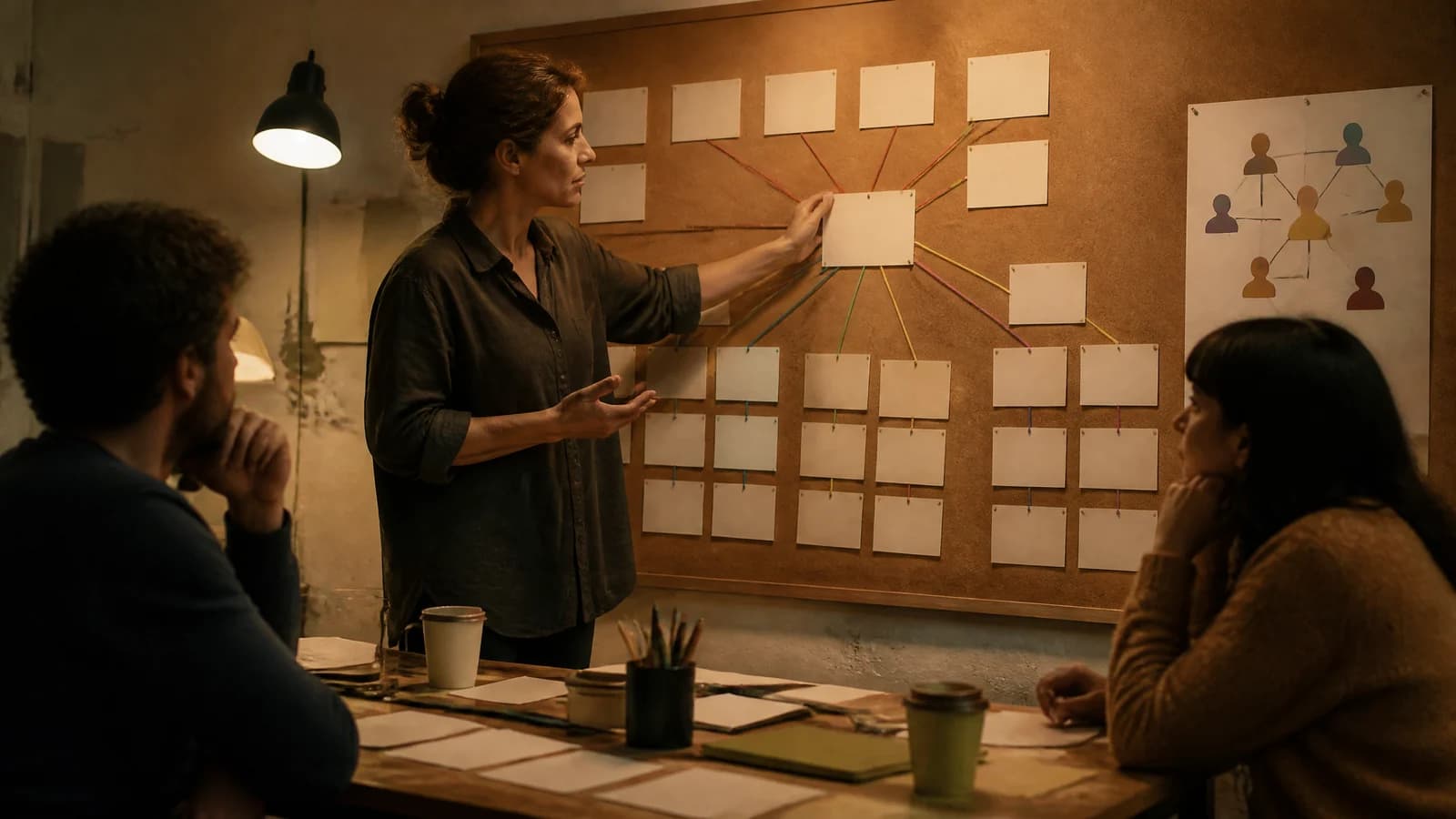
- Map 8 to 12 major turning points.
- Connect those turns through choices and consequences.
- Expand the beats into sequences or scenes.
- Track the emotional arc and important subplots.
- Draft from the outline—and let the draft argue back.
The Sundance Institute’s outline-to-first-draft course covers structure, character change, conflict, reversals, subplots, scene work, climax and resolution across the drafting process. That list is a useful reminder: an outline is not just a plot-delivery schedule. It is where external events and internal change learn to share a car.
1. Write the question the movie must answer
Begin with the protagonist, a destabilizing problem and a difficult outcome.
Try this:
Will [protagonist] achieve [concrete goal] despite [main opposition], and what must they become—or sacrifice—to do it?
For an original example, imagine a feature called Last Crossing:
Will a conflict-avoidant ferry mechanic get an injured surgeon across a storm-closed channel despite a grounded fleet, a suspicious harbor chief and the mechanic’s own buried role in a past accident?
That question gives the outline two tracks. The external track is the illegal crossing. The internal track is a woman who survives by avoiding conflict being forced to claim responsibility and take command.
If your dramatic question contains no choice, it may describe a situation rather than a movie. “Will the asteroid hit?” is weather. “Will the disgraced engineer destroy her only chance at redemption to stop it?” has a person trapped inside the weather.
2. Choose the ending before you pave the road
You do not need every detail. You do need a destination with emotional meaning.
Write three lines:
- Climax: What is the hardest action the protagonist takes?
- Answer: How does that action answer the dramatic question?
- Final image: What visible detail proves the character or world has changed?
For Last Crossing, the mechanic could complete the voyage only by publicly admitting that her earlier maintenance shortcut caused the accident that ended her career. The external win costs her the secret she built her life around. The final image is not merely the ferry reaching shore; it is the mechanic handing over the falsified logbook before anyone asks.
Now the outline has gravity. Earlier beats can prepare, complicate and eventually force that decision.
Do not confuse “know the ending” with “marry the ending.” If a stronger one appears during drafting, congratulations: the screenplay is alive.
August makes the same larger point in “Outlines Aren’t Essential”: some scripts begin with a few key moments that gradually connect, and the correct process is the one that gets the screenplay written. His online library even includes an original one-page Big Fish outline and a fuller sequence outline made after the first draft. A professional process can change shape from project to project—and from draft to draft.
3. Map 8 to 12 major story beats
Do not begin with 60 scenes. Begin with the moments that make the story impossible to return to its previous state.
A flexible feature beat sheet might contain:
- Opening imbalance: Show the protagonist’s current strategy and its hidden cost.
- Inciting disruption: Something breaks the ordinary pattern.
- First response: The protagonist tries the safest available solution.
- Lock-in choice: They commit to the central course of action.
- Early progress: The plan appears to work, revealing the movie’s promise.
- Complication: Opposition adapts or the cost becomes personal.
- Midpoint change: New information, victory or disaster changes the goal.
- Pressure closes in: The old strategy creates bigger consequences.
- Major loss: The protagonist loses the plan, ally, advantage or illusion.
- New understanding: They recognize what the final choice will require.
- Climax: Action and character change collide.
- Aftermath: The movie shows what the choice changed.
This is a checklist of dramatic functions, not a contract with Act Two. A quiet relationship drama and a contained thriller will express these turns differently. Some beats will merge. A nonlinear story may reveal them out of order. A tragedy may deliver understanding one fatal minute too late.
Structure is the pressure pattern underneath the movie—not the visible scaffolding.
4. Build a chain of choices and consequences
Here is the test that saves more outlines than a prettier template:
Because the protagonist chooses this, that becomes harder; therefore they choose the next thing.
Apply it between every major beat.
In Last Crossing, the mechanic secretly restarts the decommissioned ferry. Because she steals it, the harbor chief assumes the boat has been hijacked and orders the channel blocked. Because the official route closes, she takes the dangerous industrial passage. Because that passage passes the wreck from her old accident, the surgeon realizes she has lied about why she left the job.
The plot tightens while the character’s secret loses oxygen.
If your outline reads “and then, and then, and then,” coincidence may be driving. If every turn begins with “therefore,” the story may feel mechanically inevitable. The sweet spot is a live argument among intention, resistance, surprise and consequence.
For each major beat, ask what changes in at least two of these five areas:
- the protagonist’s plan;
- the audience’s information;
- a character’s power;
- a key relationship; and
- the potential cost of failure.
A beat that changes nothing is not necessarily subtle. It may simply be furniture.

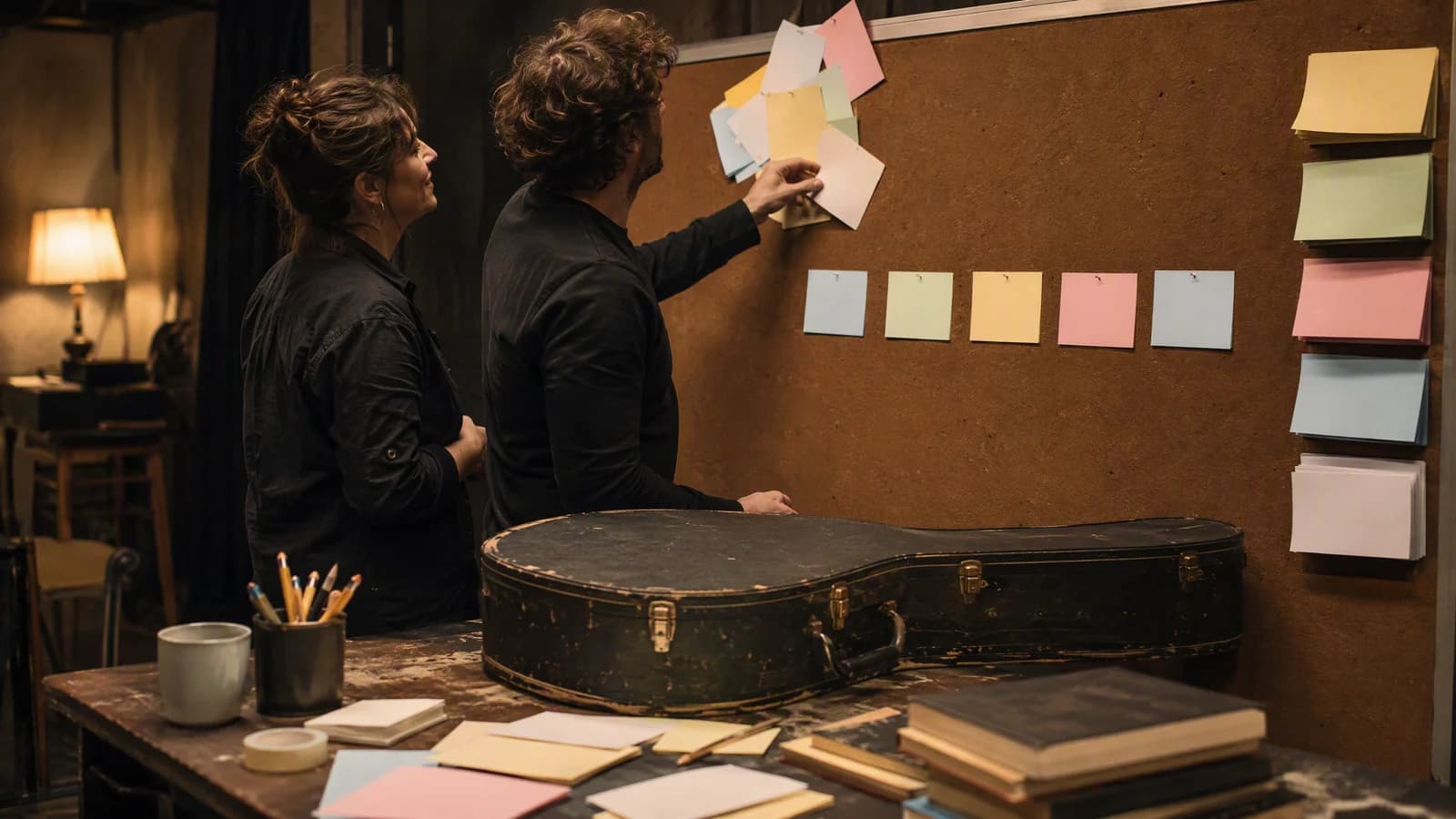
5. Expand the beat sheet into sequences or scene cards
Once the large turns hold, zoom in one level.
A sequence is a short run of scenes organized around a temporary objective. “Get the ferry out of the harbor” is a sequence. It may contain the mechanic stealing a key, bluffing a dock guard, discovering the fuel line has been stripped and persuading the injured surgeon to help repair it.
Every scene card needs only four lines:
- Want: Who wants what right now?
- Resistance: Who or what makes it difficult?
- Turn: What changes before the scene ends?
- Exit: Why must we watch the next scene?
For example:
Engine room: Mara wants the surgeon to stay hidden while she repairs the fuel line. The surgeon refuses because a deckhand is bleeding above. Mara reveals she used to be a paramedic. She must now treat the deckhand in front of the crew she has been avoiding.
Notice what is missing: polished dialogue, camera directions and four paragraphs about rust. Those belong to later decisions.
The scene-card stage is where you can move, combine or delete material cheaply. Current outlining tools make that flexibility literal. Final Draft’s structure guide describes moving beats between a visual board and an outline, while the updated Celtx beat-sheet documentation connects movable beats with the screenplay editor. Index cards, a spreadsheet and a notebook can do the same conceptual job. The best tool is the one that lets you see the story without turning software customization into your new protagonist.
How many scenes should a screenplay outline have?
As many as make the movie clear.
A private step outline might list 40 scenes or 80. A beat sheet may contain only 10 major turns. Scene count varies with genre, rhythm, length and what you call a scene. Do not add scenes to hit a suspiciously confident internet number.
Instead, make sure each listed scene creates a turn, builds necessary pressure, pays off earlier information or earns an emotional change. If three cards perform one job, audition them for a merger.
6. Track the emotional arc and subplots separately
A plot outline can look impressively busy while the protagonist remains emotionally parked.
Make a second pass using a different color or column. At every major turn, note:
- what the protagonist believes;
- what they are refusing to face;
- which relationship applies pressure; and
- what behavior proves a change.
For Mara, the internal sequence might be:
Avoid scrutiny → control the crossing alone → accept practical help → reveal partial truth → lose the crew’s trust → confess without bargaining → lead collaboratively.
That is not a separate lecture hiding beneath the plot. It should alter what she does in the ferry story.
Then map each subplot by its effect on the main line. A subplot should complicate the goal, expose another side of the theme, change a relationship or create a payoff. If it vanishes for 45 pages and returns holding a cake, it may be attending the wrong screenplay.
The Writers Guild Foundation recommends studying scripts by tracking how a writer creates emotion, constructs character change, builds tension and fulfills the story’s promise—not merely copying format or wording. Apply the same lens to your outline. The beat is not important because a diagram says “midpoint.” It is important because the audience’s experience changes there.
7. Draft from the outline without becoming its employee
Open your screenwriting software and treat each card as a question, not an order.
You know the scene’s want, resistance, turn and exit. Now discover the behavior, images, rhythm and dialogue that make it playable. Use the screenplay format guide to keep the page clean, then spend your real attention on the movie.
At the end of each writing session, update the outline to reflect what the draft actually became. This tiny habit prevents the map and the territory from beginning separate relationships.
Change the outline when:
- a character makes a more truthful choice than the planned one;
- a scene creates an unexpected consequence worth following;
- two beats collapse into one stronger turn;
- the emotional arc demands a different climax; or
- the draft exposes a logic gap the cards politely ignored.
Do not change it merely because Act Two feels difficult on Wednesday. Difficulty is not always a structural emergency. Sometimes it is writing.
A copyable screenplay outline template
Use this as a starting document. Delete any label that makes your story worse.
Story engine
- Protagonist:
- External goal:
- Main opposition:
- Internal need or false belief:
- Stakes:
- Central dramatic question:
- Climactic choice:
- Final image:
Major beats
- Opening imbalance:
- Inciting disruption:
- Safest first response:
- Lock-in choice:
- Early progress:
- Complication and rising cost:
- Midpoint change:
- Old strategy fails:
- Major loss:
- New understanding:
- Climactic choice:
- Aftermath:
Scene-card fields
- Location and participating characters:
- Immediate want:
- Resistance:
- Turn:
- Exit question or consequence:
- Emotional movement:
- Setup or payoff:
The five-minute outline stress test
Before drafting, run these questions fast:
- Does the protagonist cause at least half of the major turns through choices?
- Does the midpoint change the plan, information or power—not just the location?
- Does the opposition learn and adapt?
- Does the major loss grow from an earlier decision?
- Does the climax demand something the Act One protagonist would avoid?
- Does the final image prove change without explaining it?
- Can you remove any beat without damaging what follows?
If the outline survives, start pages. If it fails, celebrate quietly. You found the expensive rewrite while it was still a movable card.
Once the screenplay exists, compare the draft with the promise of the outline. Run the screenplay mistakes checklist, read the scenes aloud and look for places where momentum or character logic changed during drafting. For a structured outside view, create a free account. Your one welcome credit can be used for one free Quick Analysis, helping you pressure-test character, structure and pacing before the next rewrite.
Frequently asked questions about screenplay outlines
How long should a screenplay outline be?
A private screenplay outline can be one page or dozens. Use a short beat sheet to test the major turns and a longer step outline when you need scene-level guidance. If a producer, lab or employer requests the document, follow that reader’s specified length and format.
Should you outline a screenplay before writing it?
Outline before drafting if a map helps you make decisions. Start with scenes if discovery helps you find the story, then outline what you have and locate the gaps. You can also reverse-outline a finished draft for rewriting. There is no prize for suffering in the officially approved order.
What is the difference between a beat and a scene?
A beat is a meaningful change in action, emotion, information or power. A scene is a continuous dramatic unit in a place and time. One scene can contain several beats, while one major story beat can unfold across several scenes.
Do you need to use three-act structure?
No universal rule requires it. Three acts remain a useful way to think about setup, escalating confrontation and resolution, and Final Draft’s current guide presents that familiar framework. Use it when it clarifies the story. Change the model when another structure better delivers the intended audience experience.
The outline should make you want to write the movie
A perfect outline is a suspicious object. It has probably avoided contact with actors, images, rhythm, dialogue and your better ideas.
Build enough structure to see the story’s pressure. Make the protagonist choose. Make each choice rearrange the future. Track the emotional cost. Then begin the screenplay while there is still some darkness left to explore.
The outline is not the movie in miniature.
It is the trail of lit runway lamps inviting the movie to land.
Sources
- WTF Is a Beat Sheet? — John AugustAccessed 2026-08-01
- Outlines Aren’t Essential — John AugustAccessed 2026-08-01
- Library — John AugustAccessed 2026-08-01
- 5 Tips for Studying Scripts — Writers Guild FoundationAccessed 2026-08-01
- Screenwriting: From Outline to First Draft of Your Screenplay — Sundance InstituteAccessed 2026-08-01
- Building Screenplay Structure — Final DraftAccessed 2026-08-01
- Beat Sheet — CeltxAccessed 2026-08-01