Screenwriting Craft · guide
How to Write a Screenplay Treatment That Makes the Movie Feel Real
Learn how to write a screenplay treatment with the right format, length, story beats, cinematic prose, and a practical seven-pass workflow.
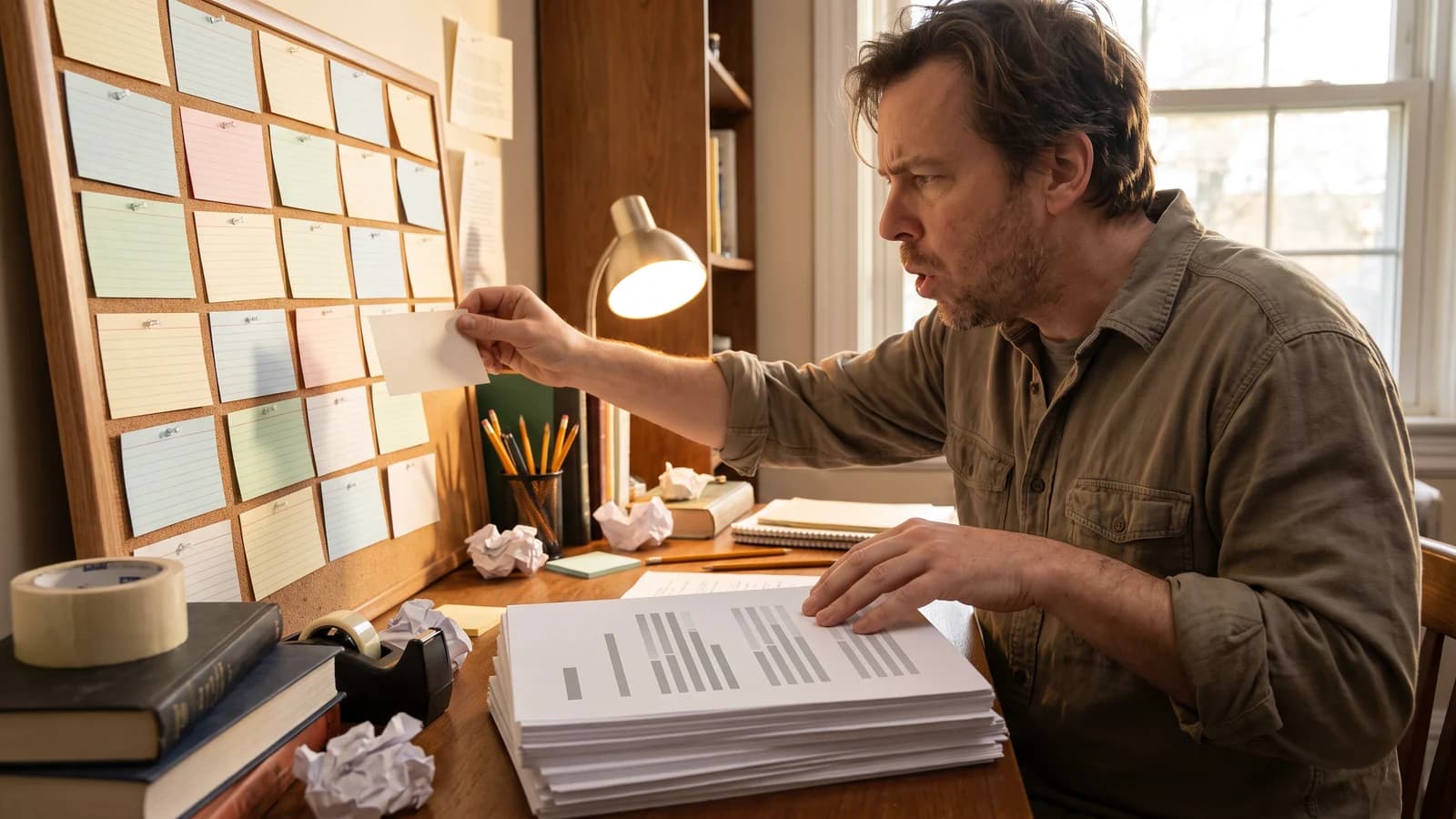
Every screenplay treatment begins with a small act of cruelty: you take the movie glowing perfectly in your head and force it to survive ordinary paragraphs.
No score. No casting fantasy. No helpful explanation from you across the table. Just the story, moving.
That is exactly why the document is useful.
A screenplay treatment is a present-tense prose version of the complete movie. It follows the protagonist through the major turns, reveals the ending, conveys tone and shows how the story will feel onscreen. To write one, build a clean cause-and-effect spine first, then add character emotion, cinematic detail and enough voice to make the reader experience the film rather than inspect its plumbing.
The treatment is not a screenplay wearing paragraph-shaped trousers. It is the movie’s persuasive rehearsal.
What is a screenplay treatment?
A screenplay treatment is a development document used mostly for feature films. It expands the shorter synopsis and outline into a fuller account of the unfolding story, including its dramatic movement, emotional arc and intended style.
Screen Australia describes treatments as both detailed development tools and selling documents: they show not only what happens, but the dramatic and cinematic way the writer intends to handle the material. Its guide places a typical feature treatment around 10 to 20 pages. Screen NSW gives the same general range and emphasizes present tense, visible and audible action, and the audience’s experience.
That 10-to-20-page range is useful—not sacred. A producer may ask for five pages. A writer may need 25 to untangle an ensemble epic. A fellowship may define an entirely different document. The correct screenplay treatment length is the length requested by the reader; when nobody has requested one, use the shortest version that makes the entire movie clear and compelling.
Treatment vs. logline, synopsis, outline and screenplay
These documents are relatives. They should not all turn up wearing the same name tag.
| Document | Main job | Typical level of detail | Does it reveal the ending? |
|---|---|---|---|
| Logline | Sell the central dramatic engine | One or two sentences | Usually implies, rather than reveals |
| Synopsis | Summarize the full plot | One paragraph to a few pages | Yes |
| Outline | Map the sequence and major turns | Beats, sequences or scene-level steps | Yes |
| Treatment | Make the whole film persuasive in prose | Major action, emotion, tone and cinematic flow | Yes |
| Screenplay | Deliver the movie scene by scene | Full action, dialogue and formatting | Yes |
If your concept still becomes vapor when reduced to one sentence, fix the logline first. If you already know the plot but cannot feel the protagonist changing inside it, the treatment is where the project earns its heartbeat.
The Sundance Institute treats this as genuine development work, not clerical garnish. Its current Core Elements course moves writers from concept to treatment through theme, character, three-act structure, visual storytelling and emotion. A separate outline-to-first-draft course accepts an outline or treatment as the foundation for drafting.
In other words: the treatment is not what you write after you solve the movie. Writing it is one way you solve the movie.
The screenplay treatment format that readers expect
There is no universal template with legally appointed margins and a treatment police unit. Clean presentation wins.
Use:
- a simple title page with the project title, writer name and contact information;
- an easy-to-read 11- or 12-point font;
- normal page margins and page numbers;
- present-tense prose;
- short paragraphs with generous white space;
- character names capitalized on first appearance if it improves clarity; and
- optional section headings when they help a longer document breathe.
Unlike a screenplay, a treatment does not need scene headings, dialogue blocks or Courier. Unlike a pitch deck, it does not need decorative layouts, casting suggestions or 46 mood images trying to perform the plot’s job.
You may include occasional dialogue when one line captures character or tone better than summary can. Keep it rare. If page three has become a wall of quotation marks, the screenplay is attempting an escape.
What a strong film treatment must contain
The treatment has one big assignment: make the reader understand the movie and want it to exist.
That requires six things.
1. A protagonist in motion
Introduce the main character through pressure, contradiction and behavior. “Lena is a perfectionist” is a label. “Lena replates the pastries at her sister’s funeral reception because one strawberry points the wrong way” is a movie.
Give us the person before the plot machinery starts, but do not hold the story in the lobby. The treatment should quickly establish what the protagonist wants, what is missing underneath that want and why this particular disruption cannot be ignored.
2. A cause-and-effect story spine
This happened. Therefore, the protagonist chooses that. But, the choice creates a worse problem. So, the protagonist risks something harder.
That chain is the treatment’s engine. Screen Australia’s story-document guide frames major turns through escalations, revelations and reversals. Those are more useful than a page-number superstition because they describe what the story is doing to the character and audience.
If five paragraphs can be rearranged without changing anything, you do not have a sequence. You have a tray of snacks.
3. The major turns—including the ending
A treatment is not jacket copy. Spoil the movie.
Include the inciting disruption, the decision that launches the central journey, major complications, the midpoint change, the worst reversal, the climax and the final emotional landing. The reader is evaluating whether the whole story works. Hiding Act Three is like asking a building inspector to admire the lobby and trust your vibe about the roof.
You do not need every scene. Include the moments without which the next important moment would not happen.
4. The emotional arc
Plot tells us Lena breaks into the closed amusement park. Character tells us why she cannot ask her estranged father for the key. The emotional arc shows how each external choice changes what she believes about him, herself and the cost of going home.
Track that change through behavior. Avoid pausing every paragraph to explain childhood wounds. Let the emotional information travel inside decisions, evasions, reversals and what the protagonist is finally willing to do.
5. Genre and tone on the sentence level
A horror treatment should generate unease. A comedy should occasionally be funny. A romantic drama should notice the charged half-second before somebody answers.
Tone does not mean adding “in a hilarious sequence” to an event that is not hilarious. It means choosing detail, rhythm and emphasis that deliver the intended experience.
The Writers Guild Foundation’s guidance on screenplay description praises prose that is vivid, economical and tuned to the film’s tone. A treatment has more narrative room than screenplay action, but the underlying lesson travels well: make us see and feel the movie without smothering it in explanation.
6. A world with selective detail
Tell us what makes this film’s arena dramatically specific. A fading seaside arcade is useful. A paragraph cataloguing every machine is a hostage situation.
Choose details that affect action, reveal character or establish a promise the story will later cash. The more unusual the world, the more clearly you must explain its rules. The more familiar the world, the less wallpaper you need to describe.
How to write a screenplay treatment in seven passes
Trying to make the first sentence beautiful before you know the ending is how writers spend Tuesday choosing a verb and Friday discovering the movie has no antagonist.
Build the treatment in passes. Each pass has one job.
Pass 1: Name the reader and the decision
Write one private sentence at the top of your working document:
This treatment must help a producer decide whether the feature has a clear, producible emotional engine.
Change the sentence for the assignment. A director may need visual possibilities. A collaborator may need structural clarity. You may simply need to know whether your clever premise can survive Act Two.
One caution: never assume a program wants a treatment because another program did. Requirements can be extremely specific. For example, the Sundance Institute’s current 2027 Development Track instructions allow treatments only for applicants being considered exclusively for the Sloan Commissioning Grant; other applicants must submit screenplay pages. Read the actual brief on the day you submit.
Pass 2: Write the ugly whole-movie spine
On one page, write the story from opening image to final image. Use blunt language. Do not charm yourself.
For each major movement, answer:
- What does the protagonist want now?
- What do they do to get it?
- What changes because of that choice?
- What harder choice follows?
If you cannot answer one, mark the gap. Do not cover it with atmosphere.
This is where you discover that the villain vanishes for 35 minutes, the love interest could be removed without disturbing the plot or the climax depends on information the hero never learns. Wonderful. A treatment found the expensive problem while it was still cheap.
Pass 3: Build eight to twelve major movements
Turn the one-page spine into sequences. The exact number does not matter; the escalation does.
A flexible feature map might look like this:
- Opening pressure and the protagonist’s current strategy.
- Inciting disruption.
- Refusal, failed containment or first response.
- Irreversible decision into the central story.
- Early pursuit and apparent progress.
- Midpoint revelation, victory or disaster.
- Consequences tighten and the old strategy fails.
- Major loss or moral trap.
- New choice based on changed understanding.
- Climax and aftermath.
This is scaffolding, not scripture. A nonlinear mystery, ensemble drama or quiet character piece may arrange pressure differently. What matters is that each movement changes the dramatic situation.

Pass 4: Turn beats into cinematic prose
Now convert the map into paragraphs that play like a movie.
Weak treatment prose reports information:
Lena learns that her father has been hiding financial problems and feels betrayed.
Stronger treatment prose dramatizes the discovery:
In the locked arcade office, Lena finds foreclosure notices folded inside the maintenance ledger. Her father catches her reading. He reaches for the papers; she holds them behind her back, suddenly twelve years old and done accepting his version of the truth.
The second version gives us a place, prop, conflict, behavior and emotional shift. It still moves quickly. That is the sweet spot.
Favor active verbs. Name concrete objects. Summarize transitions and routine business. Slow down for reversals, decisions and images that define the film.
Pass 5: Thread the internal story through the action
Read only the first and last paragraph of each major movement. Can you track how the protagonist’s strategy and emotional position change?
Add one or two precise signals where the internal journey disappears:
- a repeated behavior that changes meaning;
- a relationship choice that costs something;
- a lie the protagonist can no longer maintain;
- an image from the opening transformed in the ending; or
- a victory that feels empty because the deeper need remains unmet.
Do not attach an emotional caption to every action. “She is sad” is usually less powerful than showing what sadness makes her do badly.
Pass 6: Make the prose sound like this movie
Perform a tone pass after the structure works.
For comedy, find the social friction and humiliating specificity. For thriller, shorten the distance between choice and consequence. For horror, control what the reader knows and when the image turns wrong. For romance, notice changes in attention: who looks, who avoids looking, who remembers the ridiculous detail.
Then cut generic booster language: compelling, powerful, gripping, heartwarming, edge-of-your-seat. Those words are unpaid interns. Make the events perform the claim.
Pass 7: Cut, test and revise
Remove:
- repeated setup;
- secondary characters who receive a biography but no dramatic function;
- scene-by-scene logistics that do not change the story;
- backstory delivered before it becomes relevant;
- dialogue that merely restates the paragraph; and
- promises the ending never pays.
Give the treatment to one reader who knows nothing about the project. Ask them to tell you:
- Who is the movie about?
- What do they want?
- What makes the pursuit harder?
- Where did attention dip?
- What choice defines the climax?
- How is the protagonist different at the end?
Do not explain the answers. Collect the evidence.
A compact film treatment example
Here is the shape of an original contained drama—not a complete treatment, but a miniature showing what each movement needs to accomplish.
Setup: LENA VEGA, a meticulous city pastry chef, returns to her dying coastal hometown to sell the amusement arcade she inherited with TOMAS, the father who taught her to repair machines and then disappeared from her adult life.
Disruption: On the morning of the auction, Lena finds a teenage boy sleeping inside the prize counter. He claims Tomas promised the arcade would stay open through summer—and produces a ring of keys only Tomas could have given him.
Escalation: Lena delays the sale for 48 hours to discover what else her father concealed. Reopening one row of games draws back former employees, unpaid bills and a developer who quietly owns the debt. Each repair makes the place more alive and the sale harder to justify.
Midpoint: Tomas admits the boy is not a trespasser but Lena’s half-brother. Lena’s investigation stops being about property and becomes a choice between escaping the family story again or taking responsibility for a person she never agreed to love.
Crisis: A storm floods the arcade on the night Lena could finally sell it. Tomas suffers a stroke while trying to save the electrical room. Lena must choose between protecting the valuable machines and helping the boy reach their father through the rising water.
Climax and ending: Lena abandons the machines, gets them both out and lets the developer take the building. Months later, she and her brother run a tiny repair shop from a food-truck trailer. The first object on the bench is the arcade’s warped strawberry-shaped prize dispenser—the one thing she saved without realizing it.
Notice what is absent: most scenes, most dialogue, side-character biographies, décor inventory and a speech explaining the theme. Notice what remains: decisions, reversals, emotional causality, genre scale and a final image that answers the opening problem.
Seven screenplay treatment mistakes that flatten the movie
The synopsis stretch
The writer takes a one-page synopsis and adds adjectives until it reaches ten pages. More length is not more drama. Expand behavior, complication and emotional consequence.
The trailer voice
“In a world where nothing is what it seems…” is advertising fog. Start with a person doing something under pressure.
The mystery box with no bottom
Questions create momentum, but the treatment must reveal the answers. The reader needs to evaluate the design, not role-play opening weekend.
The perfect protagonist
If every obstacle comes from villains, weather and cruel coincidence, the main character has no meaningful arc. Let the protagonist’s current way of surviving help create the crisis.
The middle as montage soup
“They grow closer through a series of adventures” may conceal the exact story you need to invent. Identify three escalating events and the choice each one forces.
The voice-over treatment
Long explanations of thought and theme make the movie feel undramatic. Translate the important inner change into an action, relationship or visible contradiction.
The ending in witness protection
Do not fade into “and Lena must decide what family really means.” Tell us what she decides, what it costs and the final image it creates.
The final screenplay treatment checklist
Before sending the PDF, confirm:
- The first page establishes protagonist, world, tone and forward pressure.
- The central goal becomes concrete.
- Major events connect through choices and consequences.
- Escalations, revelations and reversals change the situation.
- The midpoint does more than divide the page count.
- The protagonist’s internal shift travels through behavior.
- The climax forces the story’s hardest choice.
- The ending resolves both plot and emotional journey.
- The prose stays visual, active and specific.
- The document follows the recipient’s requested length and format.
- The title, writer name, contact information and file name are professional.
- Every paragraph makes the reader want the next paragraph.
Then read it aloud. You will hear repetition, dead transitions and sentences carrying seven pieces of furniture.
Use the treatment to make the screenplay cheaper to rewrite
A good treatment does not guarantee a good screenplay. It gives the screenplay a sturdier first day.
You will still discover better scenes in the draft. A supporting character will become funnier than planned. The midpoint may demand a different betrayal. Keep the treatment alive long enough to help, then let the screenplay improve on it.
Once the draft exists, compare it with the treatment. Did the central promise survive? Did a vivid sequence replace a dull one, or did the story simply wander? Run the screenplay mistakes checklist, then check that the pages follow a readable screenplay format.
When you need an outside view, AI Script Coverage Pro can help you pressure-test character, structure and pacing against the draft you actually wrote. Create a free account, and your one welcome credit can be used for one free Quick Analysis. Use the report to find the structural note with the biggest downstream effect—then revise the story, not your voice out of it.
The treatment’s real magic is not that it predicts every scene. It makes the movie argue for itself before the screenplay asks you to build the whole set.
Sources
- Story Documents – Drama — Screen AustraliaAccessed 2026-07-28
- Glossary of Terms: Treatment — Screen NSWAccessed 2026-07-28
- Screenwriting: Core Elements — Sundance InstituteAccessed 2026-07-28
- Screenwriting: From Outline to First Draft of Your Screenplay — Sundance InstituteAccessed 2026-07-28
- Writing Your Screenplay: Description — Writers Guild FoundationAccessed 2026-07-28
- 2027 Development Track — Sundance InstituteAccessed 2026-07-28