Screenwriting Craft · screenwriting craft guide
How to Write Action Lines in a Screenplay Readers Can See
Learn how to write screenplay action lines with clarity, pace and voice, using practical rules, original examples and a seven-pass revision method.

Your hero reaches the roof. The villain raises the detonator. A helicopter claws through the rain. And your screenplay says:
They fight.
Congratulations. You have just handed the most expensive, dangerous and possibly most entertaining part of the movie to somebody else.
Here is the direct answer: to write strong action lines in a screenplay, describe the visible and audible event in present tense, choose specific verbs, break the action into readable beats and make each paragraph change the picture. Keep the prose lean, but not empty. The job is to make a reader see the movie at the speed and in the tone you intend.
Action lines are not the gray matter between the dialogue. They are the movie: entrances, glances, discoveries, pratfalls, kisses, escapes, silences and the hand that does not reach for the gun.
Screenplay action lines at a glance
| Do this | Why it works |
|---|---|
| Write in present tense | The movie appears to happen now |
| Describe what can be seen or heard | The line gives actors and filmmakers something playable |
| Lead with a precise subject and verb | The reader understands the picture immediately |
| Start a new paragraph when the beat changes | White space controls pace and emphasis |
| Include only details that affect story, tone or staging | The page stays vivid without becoming a furniture inventory |
| Let the prose sound like the movie | Comedy, horror and thriller action should not read identically |
| Break a convention only for a clear effect | Style serves the read instead of advertising itself |
That is the map. Now let us put weather on it.
What is an action line in a screenplay?
An action line—also called action, description or scene description—is the left-aligned prose that tells us what the audience sees and hears. It appears beneath a scene heading and between passages of dialogue.
If scene headings, margins and character cues are still competing for your attention, settle those mechanics with the screenplay format guide. This article tackles the part software cannot automate: making the description worth reading.
INT. ALL-NIGHT LAUNDROMAT - NIGHT

Every washer churns except one.

MARA, 34, still wearing her restaurant apron, kneels before the dead machine. A red sock clings to the glass from inside.

It knocks twice.
The action does four jobs quickly. It establishes the room, introduces Mara, plants a specific object and changes an ordinary image into a disturbing one.
The Academy’s screenwriting activities guide frames film as a visual medium, distinct from fiction that can live inside a character’s mind. That does not mean screenplays are emotionless instruction manuals. It means emotion must arrive through an experience the audience can receive: behavior, image, sound, rhythm and context.
You can write “Mara knows she should leave,” but the camera cannot photograph knowledge. You can write this:
Mara backs toward the door.

The sock knocks again.

She turns the deadbolt.
Now fear has made a choice.
The six working rules of action description
1. Use present tense—even when the story is in the past
Screenplay action happens in the reader’s immediate imagination.
Flat: Mara walked to the washer and had opened its door.
Clear: Mara crosses to the washer. She opens the door.
The second version does not merely satisfy convention. It removes the grammatical distance between the reader and the event.
Present progressive constructions are not illegal. Sometimes “Rain is hammering the roof” creates a useful continuing condition. But “Rain hammers the roof” is shorter, stronger and usually easier to picture. Reach for the active verb first.
2. Write what plays, not what the author privately knows
“Theo remembers his father” is information. It is not yet a moment.
What changes in his body? What does he notice? What choice does the memory provoke?
Theo finds his father's initials carved under the workbench.

He sets down the eviction notice. Picks up the old chisel.
The Writers Guild Foundation’s description primer recommends description that emphasizes what the viewer sees and hears while hinting instead of over-explaining. That word hinting matters. Visible writing is not the same as emotionally obvious writing.
An actor does not need you to prescribe every blink. Give them a playable circumstance, a consequential behavior and room to perform.
3. Put the subject and the change where the eye can find them
Action becomes foggy when the sentence hides the important event behind setup.
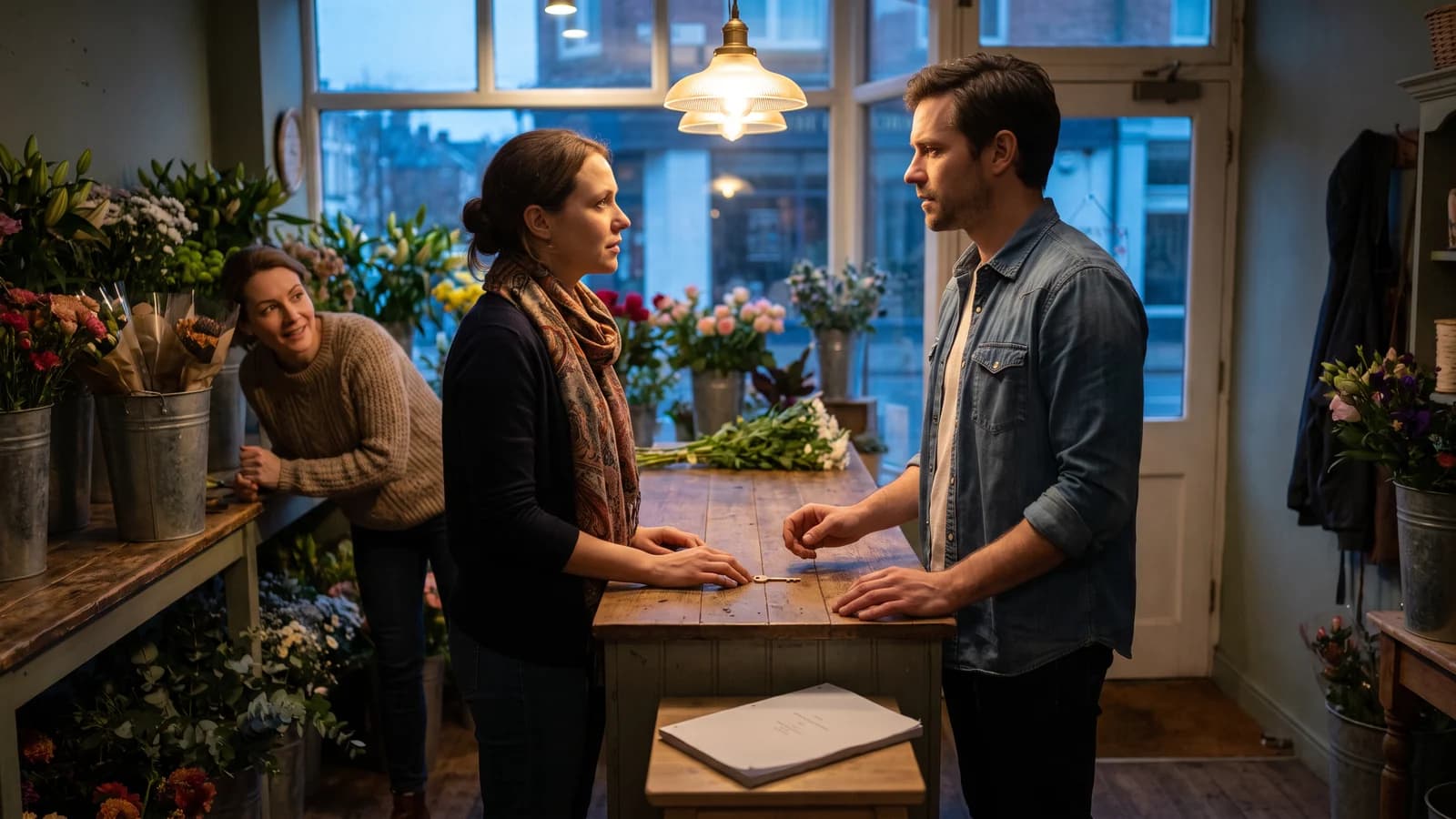
Foggy: As the noise from the traffic outside continues and everyone else in the diner remains occupied, something underneath June’s coffee cup appears to catch her attention.
Visible: A key peeks from beneath June’s coffee cup.
She palms it. Nobody notices.
The rewrite answers two questions in order: what changed, and what did the character do about it?
Specific verbs carry more movie than decorative adverbs. A character does not “move quickly” when they can bolt, lunge, scramble or flee. Those verbs are not interchangeable. Each one casts the body differently.
4. Break the paragraph when the beat changes
Paragraphing is editing before there is footage.
Leon eases the apartment door open. Dark inside. Silent.

He steps across the threshold.

Behind him, the elevator dings.
If those three beats occupy one block, the ding lands like another fact. Isolated, it becomes an event.
In Scriptnotes 206, John August and Craig Mazin examine how very different produced screenplays use nouns, verbs, punctuation and paragraph shapes to move the eye through a scene. The useful lesson is not “every paragraph must be two lines.” It is that the page has rhythm, and the writer is responsible for it.
Short blocks generally invite speed. A denser paragraph can slow the read, immerse us in a new place or make an accumulating disaster feel inescapable. Long is not automatically wrong. Accidental is wrong.
Paragraph rhythm can accelerate a moment, but it cannot replace a dramatic turn. Use the companion guide to writing a screenplay scene when the page moves quickly yet the story stays put.
5. Describe the detail that changes the story
A location is not a real-estate listing.
INT. KITCHEN - MORNING

A bright kitchen with marble counters, white cabinets, a large refrigerator, six stools, copper pans and a bowl of fruit on the island.
The paragraph contains objects. It does not contain a point of view.
Try this:
INT. KITCHEN - MORNING

The kind of kitchen nobody cooks in.

Nico saws a birthday cake with a bread knife. Pink crumbs everywhere.
Now the room has social meaning, the prop creates behavior and the mess contradicts the setting. The production designer still has freedom. The reader has a movie.
6. Let the action prose belong to this movie
A romantic comedy can notice embarrassment. A horror script can withhold the corner of a room. A heist can make every object feel like a mechanism.
In Scriptnotes 463, August and Mazin compare action writing across genres and styles, arguing that description should feel as though it belongs in the same world as the characters. Voice does not require purple prose. It requires selection.
Consider one event in three registers:
Thriller: The service door clicks shut. Ava tries the handle. No give.
Comedy: The service door locks behind Ava with the tidy confidence of a decision she did not make.
Horror: The service door settles into its frame. Softly. Permanently.
Same door. Different movie.

How long should screenplay action lines be?
There is no union representative hiding behind your printer with a three-line ruler.
For a spec script, one to four lines per paragraph is a useful default because it keeps the page approachable and makes each beat easy to identify. But paragraph length should follow the reading experience. A strange new environment may earn a fuller introduction. A chase often wants quick, separated impacts. A devastating realization may deserve one line and a lot of air.
The craft discussion in Scriptnotes 463 shows accomplished screenwriters succeeding with both spare and dense approaches. The hosts’ real standard is whether the reader stays engaged with every word.
Ask three better questions than “Is this paragraph too long?”
- Does the block contain more than one dramatic beat?
- Is the most important image buried in the middle?
- Would removing a sentence change what the reader sees, hears or feels?
If the answers are yes, yes and no, the paragraph is not long. It is hiding.
Can you write thoughts and feelings in action lines?
Yes—with judgment.
The rigid beginner rule says to write only what the camera can photograph. The professional practice is more elastic. A brief interior phrase can orient the reader, land a joke or sharpen the meaning of visible behavior.
Rina checks the empty chair beside her. Still saving it for someone who is not coming.
The second sentence is not literally photographable, but it tells us how to read the first. If the chair, the waiting and the surrounding scene support that idea, the line helps.
Trouble begins when interior language replaces drama:
Rina thinks about every mistake she has made and wonders whether love is possible for someone like her.
Nothing happens. The actor gets an essay instead of an action.
Turn the thought into pressure:
Rina deletes his number.

Types it back from memory.
That contradiction can be performed. Better yet, it contains the argument without announcing it.
“We see,” camera directions and other imaginary crimes
You may use “we see.” You may use a camera direction. You may capitalize a sound. The screenplay will not burst into flames.
In Scriptnotes 533, August and Mazin explicitly reject a blanket ban on “we see” and “we hear.” Those phrases are tools for directing the reader’s attention. The question is whether the effect is clearer than a direct sentence.
Unnecessary: We see a muddy footprint on the tile.
Direct: A muddy footprint stains the tile.
Useful: We move past the family portrait to find one face cut out.
The useful version defines a reveal: first this, then that. You could phrase it differently, but the sentence is doing visual work.
Treat camera language the same way. “CLOSE ON,” “ANGLE ON” and “PAN TO” can become fussy when they narrate coverage the director already understands. Use them when the shot itself carries essential information or creates a precise audience experience.
Do not write twenty camera moves to prove you have watched movies. Write the one reveal the scene cannot survive without.
Action line or parenthetical?
Put meaningful action in an action line. Reserve parentheticals for a compact instruction that changes how a line is delivered or clarifies a tiny simultaneous behavior.
MARA
(into the phone)
I'm already outside.

She is still in bed.
The parenthetical makes the delivery legible. The action line holds the visual joke.
Scriptnotes 533 offers essentially this dividing principle: action usually belongs in action, while a very small behavior may sit in a parenthetical when splitting the dialogue would damage the read.
If your parenthetical contains a small stage play—“crossing to the window, remembering their first date and trying not to cry”—move the behavior out and decide which part actually matters.
How to write a real action sequence
“They fight” is not brevity. It is an unpaid invoice addressed to the stunt team.
You do not need to choreograph every fist angle, but you must write the changing contest. Track goal, geography, obstacle and consequence.
Suppose Mara needs the laundromat’s back-door key while something moves inside the dead washer.
Step 1: Give the character a concrete objective
Mara is not “trying to survive.” She is crossing fifteen feet to the key hook.
Step 2: Establish usable geography
The washers form one narrow aisle. The front door is locked. The key hangs behind the counter. The dead washer blocks the shortest path.
Step 3: Change the advantage
Every few beats, somebody or something gains ground, loses a tool, discovers information or changes the plan.
Mara vaults the folding table.

The dead washer SHUDDERS sideways, sealing the aisle.

She hurls the detergent bottle. It bursts against the glass—blue liquid sheets down.

For one second, the thing inside is perfectly outlined.

It has her shape.
Step 4: Make the ending cost something
Mara gets the key, but must abandon the phone containing the only proof. She escapes the room and worsens the story.
Action is not movement for its own sake. It is choice accelerated.
The same pressure should continue when characters stop running and start talking. Strong screenplay dialogue is action by another means: somebody wants an outcome and changes tactics to get it.
Eight common action-line mistakes
1. The novel opening
Three paragraphs of history arrive before anybody does anything. Keep the relevant history; attach it to a present image or decision.
2. The unfilmable diagnosis
“He has commitment issues.” Show him removing his toothbrush from her bathroom before she wakes.
3. The prop warehouse
Every lamp, chair and framed photograph receives equal billing. Name the object the scene uses.
4. The thesaurus stunt
Simple physical action becomes a parade of strained synonyms. Precision is not the same as ornament.
5. The paragraph brick
Setup, action, reversal and punchline share one gray block. Give the turn its own air.
6. The puppet master
Every breath, nod and finger movement is prescribed. Write the behavior that changes meaning; trust performers with the connective tissue.
7. The trailer voice
“In a world where nothing is what it seems...” is selling atmosphere instead of creating an event. Put the strange thing in the room.
8. The vanished sequence
“An incredible chase follows.” If it is in the movie, it is part of your job. Scriptnotes 463 makes this point forcefully: action sequences cannot simply be handed off in the prose.
The seven-pass action-line rewrite
Do not attempt to make every sentence lean, visual, tonal and perfectly paced at once. Give the scene seven fast passes.
This is the prose-level pass, not the entire revision. If the sequence itself no longer belongs in the movie, step back to the larger process for rewriting a screenplay before polishing its verbs.
Pass 1: Circle every change
Mark what enters, exits, moves, breaks, appears, disappears or becomes understood. If a paragraph has no change, ask why it exists.
Pass 2: Underline every verb
Replace weak constructions where a precise active verb makes the image faster. Do not swap ordinary clarity for acrobatics.
Pass 3: Test filmability
Highlight thoughts, backstory and judgments. Keep the rare interior phrase that genuinely guides the read. Convert the rest into evidence.
Pass 4: Track the eye
Read each sentence as a sequence of pictures. Does the important object appear before the action involving it? Can the reader understand where people are?
Pass 5: Rebuild the paragraphs
Start a new block for a new action, reaction, reveal, turn or emphasis. Read the white space as part of the scene.
Pass 6: Tune the voice
Would this description sound at home beside the movie’s dialogue? Cut generic phrases. Add one exact observation where the scene needs personality.
Pass 7: Read only the action
Skip every line of dialogue and read the description straight through. Can you follow the physical and emotional story? Then do the reverse: read only the dialogue. The two tracks should complement each other, not duplicate each other.
The Writers Guild Foundation’s broader Screenplay Primers collection models the most useful next step: study how produced scripts solve specific problems across genres rather than copying one supposedly universal house style.
A before-and-after action-line example
Here is a deliberately overloaded first pass:
Feeling deeply nervous because this is the first time she has been back since her mother died, Elena slowly walks into the old greenhouse, which is dusty and filled with many dead plants and gardening equipment that has not been touched for a long time. She looks around sadly and remembers being there as a child. She notices the watering can on the table and walks toward it, then sees a fresh puddle underneath it, which surprises her because the greenhouse has been locked.
The information is usable. The experience is not.
Elena unlocks the greenhouse.

Dead vines web the glass. Rusted tools exactly where her mother left them.

Elena stays in the doorway.

On the potting table: her mother's green watering can.

A fresh puddle spreads beneath it.
The rewrite removes the emotional labels but makes grief and fear more available. It separates arrival, recognition, hesitation, object and impossible change. It also gives the reader one strong color detail instead of a catalog.
Could the paragraph be written another way? Absolutely. That is the point. Action writing is not compression toward one correct answer. It is design toward one intended experience.
Your final action-line checklist
Before sending the draft, ask:
- Is every action written as if it happens now?
- Can the reader picture who does what, where and in what order?
- Does each paragraph contain one main beat?
- Are thoughts supported by visible behavior?
- Do the verbs create specific physical action?
- Does description carry the movie’s tone?
- Are important reveals placed at the ends of sentences or paragraphs?
- Does every named detail earn story, character, atmosphere or production value?
- Can a collaborator act, stage, design or shoot what is written?
- Have I actually written the sequences the movie promises?
Action lines are not where your voice goes to behave. They are where your movie becomes visible.
When you have a full draft, familiarity can make missing geography, repeated beats and soft escalation almost invisible. Create a free AI Script Coverage Pro account, receive one welcome credit, and use it for one free Quick Analysis. Compare the report’s view of pacing, character action and scene momentum with the experience you designed—then make the prose move like the movie in your head.
The next time your hero reaches the roof, do not write “they fight.” Write the changing advantage, the costly choice and the image nobody else would have chosen.
Sources
- Writing Your Screenplay: Description — Writers Guild FoundationAccessed 2026-10-10
- Scriptnotes, Episode 206: Everything but the Dialogue — John AugustAccessed 2026-10-10
- Scriptnotes, Episode 463: Writing Action — John AugustAccessed 2026-10-10
- Scriptnotes, Episode 533: We See and We Hear — John AugustAccessed 2026-10-10
- Complete Screen Writing Activities Guide — Academy of Motion Picture Arts and SciencesAccessed 2026-10-10
- Screenplay Primers — Writers Guild FoundationAccessed 2026-10-10