Industry & Careers · filmmaker craft profile
Aaron Sorkin’s Screenwriting Method: 8 Lessons Beyond the Walk-and-Talk
Learn Aaron Sorkin’s screenwriting method through eight practical lessons on conflict, dialogue, exposition, research, first drafts, and rewriting.

Aaron Sorkin has accidentally convinced a generation of screenwriters that the secret is walking quickly through expensive hallways while saying clever things.
It is not.
The walking is staging. The cleverness is surface. Underneath both is a brutally simple dramatic machine: somebody wants something, something is in the way, and every line is a tactic for winning.
Here is the useful answer: Aaron Sorkin’s screenwriting method starts with intention and obstacle, turns disagreement into action, treats dialogue as composed sound, and discovers structure by writing toward conflict rather than obeying a preset outline. Then it rewrites. A lot.
The method is especially worth revisiting now. In September 2026, Sorkin gave Scriptnotes a detailed tour of his current writing process, using scenes from The West Wing and The Social Network as case studies. On October 9, Sony released The Social Reckoning, his companion film to The Social Network. New work, fresh explanations, same load-bearing principle: drama begins when desire meets resistance.
You do not need to imitate Sorkin’s rhythms, politics or fondness for very articulate people under fluorescent light. You need to steal the engineering.
The Aaron Sorkin screenwriting method in eight moves
Across Sorkin’s recent Scriptnotes interview, his MasterClass material and conversations about Being the Ricardos, Molly’s Game and The Social Reckoning, eight repeatable habits emerge:
- Find intention and obstacle before writing the scene.
- Begin with a first scene you can hear—not an ending you can prove.
- Turn every conversation into a form of action.
- Give both sides the dignity of a real case.
- Smuggle exposition through conflict.
- Compose dialogue for the ear, then make it playable.
- Research until you can identify the dramatic truth.
- Finish the draft and let the ending rewrite the beginning.
This is not a formula for producing knockoff Sorkin dialogue. Nobody needs a dentist arguing constitutional law at 240 words per minute. It is a method for making scenes move.
1. Find intention and obstacle before writing the scene
Sorkin returns to two words so often that they can sound like a slogan: intention and obstacle.
They are more useful as a diagnostic.
Before writing a scene, answer:
- What does this person want before the scene ends?
- Who or what prevents them from getting it?
- What tactic do they try first?
- What tactic appears when the first one fails?
- What will success cost?
Notice what is missing: biography, theme, likability, the character’s favorite breakfast cereal. Those details can matter later. They do not create motion.
Sorkin tells Scriptnotes that he needs intention and obstacle before he can write a scene. His MasterClass guidance goes further: character grows from the specific pressure of wanting something and meeting resistance, not from pages of private backstory.
Imagine a city council aide needs her boss to delay a vote.
The flat version is a conversation about why the vote is dangerous.
The dramatic version gives each person an immediate objective:
- The aide needs a public delay before the press conference in ten minutes.
- The council member needs the vote today or loses a wavering ally.
Now information has teeth. The aide begins with evidence, switches to loyalty, threatens resignation, then reveals she already called the press. Each tactic exposes character because pressure forces a choice.
Steal this: write the intention as a playable verb—delay, recruit, corner, forgive, expose—not a feeling such as be understood. Then give the opposing character a verb that cannot peacefully coexist with it.
2. Begin with a first scene you can hear—not an ending you can prove
Sorkin does not describe himself as a conventional outliner.
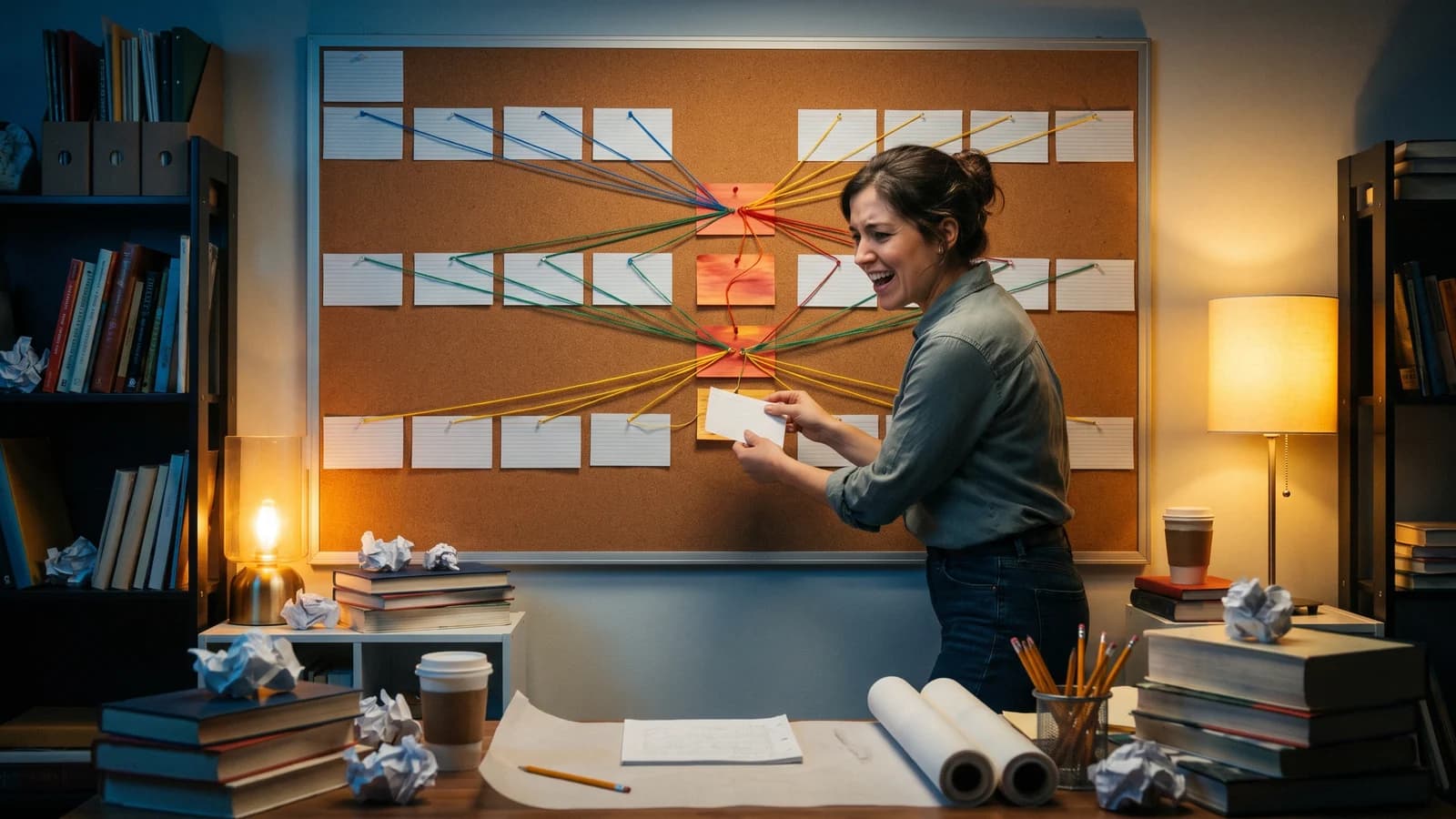
In the 2026 Scriptnotes conversation, he compares his process to moving through dark woods with a flashlight: the next patch becomes visible only after he walks toward the current one. He may use index cards, but he does not wait for a complete map or even a known ending. He needs the first scene to become vivid enough that writing it feels almost like taking dictation.
This is liberating advice with a trapdoor underneath it.
“I do not outline” does not mean “I wander without dramatic information.” Sorkin may not know the final destination, but he knows who wants what in the scene under the flashlight. The local engine is precise even when the global route is not.
Try a flashlight outline:
| What you know now | What you may leave unknown |
|---|---|
| The protagonist’s immediate objective | The final image |
| The force opposing that objective | The exact midpoint reversal |
| The choice that ends scene one | The number of sequences |
| The consequence that begins scene two | The finished theme statement |
Write three cards, not thirty:
- Entry pressure: Why must the scene happen now?
- Collision: Which tactic makes the situation harder?
- Exit damage: What changes so the next scene becomes necessary?
If those cards generate momentum, walk farther. If they do not, another twenty-seven cards will only give the problem office furniture.
Writers who prefer a full map should keep one. Our screenplay outlining guide offers a more expansive process. The Sorkin lesson is not that outlines are timid. It is that an outline must preserve discovery. A scene should still be capable of surprising the person writing it.
Steal this: stop planning at the first decision you genuinely cannot predict. Draft until the character makes it. Then update the route from the consequences.
3. Turn every conversation into a form of action
Sorkin’s characters talk constantly. They are rarely “just talking.”
On Scriptnotes, he recalls director Mike Nichols’s useful claim that a scene is a negotiation, a fight, a seduction or a discovery. Whether or not every scene fits neatly into one box, the framework forces a writer to ask what the language is doing.
Use it as a scene test:
| Scene mode | The language is trying to… | Warning sign |
|---|---|---|
| Negotiation | Exchange value without surrendering leverage | Both sides repeat fixed positions |
| Fight | Injure, dominate or force retreat | The argument changes no behavior |
| Seduction | Make the other person want the offered future | Attraction exists without risk |
| Discovery | Change the meaning of known facts | Information arrives without a decision |
A breakup can be a negotiation if both people are dividing the future. A budget meeting can be a seduction if a producer is selling everyone on a dangerous version of the movie. A first kiss can be a fight if each character needs control of what it means.
This is why Sorkin’s scenes can remain kinetic in offices, depositions and control rooms. The characters are using speech to do something to one another.
Take a scene where a daughter tells her father she is moving out.
If the scene is “a conversation about moving,” it may collect explanations.
If the scene is a negotiation, every line tests the price of independence. He offers money. She refuses. He calls the refusal reckless. She reveals the deposit is already paid. He asks for the address. She changes the subject. The scene has movement because the tactics move.
Our guide to writing a screenplay scene begins from the same premise: a scene is a change under pressure, not a container for dialogue.
Steal this: label the scene with a mode before rewriting it. Then cut any line that does not strengthen a tactic, force a response or change the mode.
4. Give both sides the dignity of a real case
Sorkin’s signature conflict is often a conflict of ideas. The danger is assuming this means one brilliant character teaches a slower character the theme.
That is not conflict. That is a podcast with blocking.
The stronger Sorkin principle appears in his approach to real people. While discussing The Social Reckoning with Vanity Fair, he explained that he could not write Mark Zuckerberg by judging him from outside. The character had to make the strongest possible case for himself.
Apply that generosity to everybody in the scene, including the person who is wrong.
Build a case file for each side:
- What fact are they right about?
- What value are they protecting?
- What personal history makes their position reasonable?
- What would accepting the other argument cost them?
- Where does their best quality become dangerous?
Suppose a surgeon wants to attempt a risky operation and an administrator wants to cancel it. The lazy scene gives the surgeon courage and the administrator cowardice. The live scene lets the administrator understand that one spectacular rescue could close the underfunded unit after the next preventable death. Now both positions protect patients. The argument hurts because virtue is colliding with virtue.
Do not confuse fairness with neutrality. The screenplay can know which choice it believes is right. It simply earns that belief by surviving the strongest opposing case.
Steal this: write one paragraph arguing the scene from the antagonist’s point of view. If it sounds like a position no intelligent person would hold, the protagonist has nothing worth defeating.
5. Smuggle exposition through conflict
Exposition is unnatural. People do not usually explain the facts both of them know unless somebody is lying, testing, accusing, persuading or trying to change the record.
Sorkin’s answer is not to remove information. It is to make the information contested.
In the 2026 Scriptnotes case study, Sorkin and John August examine a deposition sequence from The Social Network. The legal setting supplies opposing goals, status games and consequences for every answer. Facts emerge because one side is trying to pin down an account and the other is trying to control it.
That principle travels far beyond courtrooms.
Instead of:
As you know, the reactor has been unstable since the cooling failure three years ago.
Give the fact a job:
MARA
You called it stable in front of the board.
ELIAS
I called it containable. Three years ago. Before you cut the second coolant line.
The audience learns the history while tracking blame, terminology and power.
Use the contested-exposition pass:
- Who benefits if this version of events becomes official?
- Which fact is embarrassing, incriminating or expensive?
- What word would the two characters define differently?
- Why is the information being raised now?
- What decision depends on the answer?
If nobody has a reason to resist the information, consider moving it into action. Show the damaged coolant line. Let the elevator reject the old access card. Put the wrong name on the reservation. Visual evidence is often faster than a beautifully engineered argument.
Steal this: highlight every line whose main job is to inform the audience. Give half of those facts an owner who wants them believed and the other half an opponent who needs them challenged.
6. Compose dialogue for the ear, then make it playable
Sorkin treats dialogue as music. That phrase is often used to excuse ornamental speeches. His more practical point is about sound, performance and pressure.
In the Scriptnotes interview, he says the sound of a line matters alongside its meaning and describes speaking every role aloud while he works. His MasterClass material makes the same recommendation: dialogue is written to be performed, so the writer should hear it, not merely inspect it.
Run four separate dialogue passes:
The tactic pass
Write the verb beside each line: flatter, evade, corner, shame, recruit. If five lines use the same tactic, the scene is idling.
The breath pass
Read the scene at performance speed. Mark where you naturally breathe. A sentence that looks elegant may be physically hostile to the actor. Long lines can work; unshaped lines usually do not.
The sound pass
Circle repeated sentence lengths, soft endings and accidental tongue-twisters. Listen for the word that deserves the beat. Put it where the actor can land it.
The ownership pass
Cover the character names. Can you tell who is speaking from vocabulary, rhythm, evasion and priorities? Fast dialogue is not a voice. It is a tempo.
Sorkin tells The Talks that he is drawn to language-rich films and courtroom drama because intentions, obstacles and stakes are unusually clear. That order matters. The musicality works because the dramatic argument gives it a bass line.
Our full guide to screenplay dialogue goes deeper on subtext and voice. The Sorkin addition is to make language pleasurable without letting pleasure stop the scene.
Steal this: record yourself reading both roles while walking. The body will expose lines that have no breath, tactics that do not turn and paragraphs that exist only because they looked impressive on the screen.
7. Research until you can identify the dramatic truth
Sorkin frequently writes about real people. That creates a craft problem and an ethical one: facts are abundant, but a screenplay still needs selection, causality and point of view.
His process begins broadly. In a Script Magazine interview about Being the Ricardos, Sorkin describes reading available material, talking to people and eventually choosing one pressured week as the structure. Research supplied the world. Dramatic compression supplied the movie.
For The Social Reckoning, Vanity Fair reports that he spent roughly a year and a half using Facebook and found his dramatic route through whistleblower Frances Haugen and The Wall Street Journal investigation. The useful lesson is not “spend eighteen months on social media and call it research.” It is that research becomes story only when it reveals a human carrier for the conflict.
Build a research funnel:
- Collect: timeline, primary documents, interviews, places, competing accounts.
- Question: which contradiction refuses to disappear?
- Choose: whose objective turns that contradiction into scenes?
- Compress: what time container creates the greatest pressure?
- Audit: which changes clarify meaning, and which create a false impression?
The last step matters. “Dramatic truth” is not permission to manufacture whatever makes the third act exciting. Keep a ledger with three columns:
| Story element | Evidence | Dramatic treatment |
|---|---|---|
| Public event | Primary report and two corroborating accounts | Re-created closely |
| Private conversation | Outcome documented; words unknown | Invented dialogue consistent with known positions |
| Compressed timeline | Events occurred over six months | Combined into one week and disclosed in production notes |
Even when you are writing fiction, the funnel helps. Research should not make the screenplay show how much homework you did. It should uncover the precise pressure your imagination could not fake.
Steal this: after a research day, forbid yourself from adding facts to the script. Add one conflict, one behavior and one difficult choice instead.
8. Finish the draft and let the ending rewrite the beginning
Sorkin’s discovery process would be romantic if it did not end in an enormous amount of rewriting.
In both Scriptnotes and Script Magazine, he advises reaching the end even when parts of the draft are not working. The finish reveals what the screenplay is actually about. Only then can the beginning be rewritten with that knowledge.
That gives you a clean two-draft bargain:
Draft one: acquire the movie
- Protect forward motion.
- Leave placeholders for research holes.
- Mark weak scenes without polishing them.
- Follow consequences, even when they break the plan.
- Reach a real ending.
Draft two: make the movie look inevitable
- Rewrite the opening around what the ending proves.
- Strengthen the central intention and obstacle.
- Remove subplots that never press the main conflict.
- Plant information before it becomes convenient.
- Replace repeated tactics with escalation.
- Cut the last line of every scene and see which ones improve.
That final trick comes directly from Sorkin’s 2026 Scriptnotes conversation. Last lines often explain the turn the audience has already felt. Cutting them can make the scene end on behavior, impact or an unanswered challenge.
He also suggests ending a productive writing session before the scene is finished—ideally while the next move is still obvious. It is the opposite of waiting for a clean stopping point. You leave tomorrow’s writer a lit runway.
Use a disciplined screenplay rewrite process when the draft is complete. The goal is not to polish every line into Sorkin-like brilliance. It is to make the causal engine so clear that style has somewhere to go.
Steal this: finish one troublesome scene without correcting it. Then write the next scene. The new consequence may tell you what the earlier scene was supposed to do.
The Sorkin scene test
Run this test on a dialogue-heavy scene that feels smart but strangely still:
| Question | Strong answer | Warning sign |
|---|---|---|
| What does each character want now? | Two specific, incompatible outcomes | One person wants to explain the plot |
| What is the scene mode? | Negotiation, fight, seduction or discovery | “Conversation” |
| Which tactic changes first? | A failed tactic forces a sharper one | Everyone restates a position |
| What fact is contested? | Information changes leverage | Both people politely agree on history |
| Where does the scene turn? | A choice, reveal or reversal changes the plan | The topic simply ends |
| Can an actor play the language? | Breath, emphasis and rhythm support action | The line exists mainly to impress the reader |
| What happens if the last line disappears? | The scene lands earlier and harder | Nothing changes because nothing landed |
If the scene fails three or more rows, do not begin by making the dialogue faster. Clarify the dramatic transaction.
What not to copy from Aaron Sorkin
Studying a recognizable writer creates a predictable hazard: mannerisms are easier to imitate than principles.
Do not automatically copy:
- rapid-fire banter;
- walk-and-talk staging;
- grand speeches;
- hyper-articulate experts;
- institutional workplaces;
- references that prove everybody read the same books;
- the belief that speed equals intelligence.
Instead, copy the hidden choices:
- desire arrives early;
- resistance is intelligent;
- dialogue changes leverage;
- exposition is fought over;
- rhythm serves performance;
- research finds a human conflict;
- rewriting makes discovery look designed.
The point is not to sound like Aaron Sorkin. It is to make your own characters sound like they urgently need the next line.
Make the words do something
Sorkin’s best-known scenes are fun to quote, but quotation is not why they work. The lines prosecute, bargain, seduce, conceal and detonate. Remove the objective beneath them and the music becomes hold music.
So start smaller than style.
Give one character a concrete intention. Put a worthy obstacle in the room. Let both sides make the strongest case they can. Read the result aloud. Finish the draft. Return with the ending in your pocket and rewrite the beginning as if you knew it all along.
That is the part of Aaron Sorkin’s screenwriting method worth stealing.
If your dialogue is lively but you cannot tell whether the scene is actually turning, get a fresh read. Create a free AI Script Coverage Pro account, receive one welcome credit, and use it for one free Quick Analysis. Compare the report’s view of conflict, character motivation, pacing and clarity with the scene you intended—then rewrite the cause, not just the cadence.
Sources
- Aaron Sorkin on His Writing Process | Scriptnotes — John August / ScriptnotesAccessed 2026-10-30
- Aaron Sorkin’s First Interview About His Social Network Follow-Up — Vanity FairAccessed 2026-10-30
- 8 Tips for Aspiring Screenwriters from Aaron Sorkin — MasterClassAccessed 2026-10-30
- Overcoming Obstacles: An Interview with Aaron Sorkin — Script MagazineAccessed 2026-10-30
- Aaron Sorkin — The TalksAccessed 2026-10-30
- The Social Reckoning — Official Teaser Trailer — Sony Pictures EntertainmentAccessed 2026-10-30