Screenwriting Craft · guide
How to Write a Short Film Script That Earns Every Minute
Learn how to write a short film script with one decisive change, visual storytelling, a filmable scope, and a practical page-by-page plan.
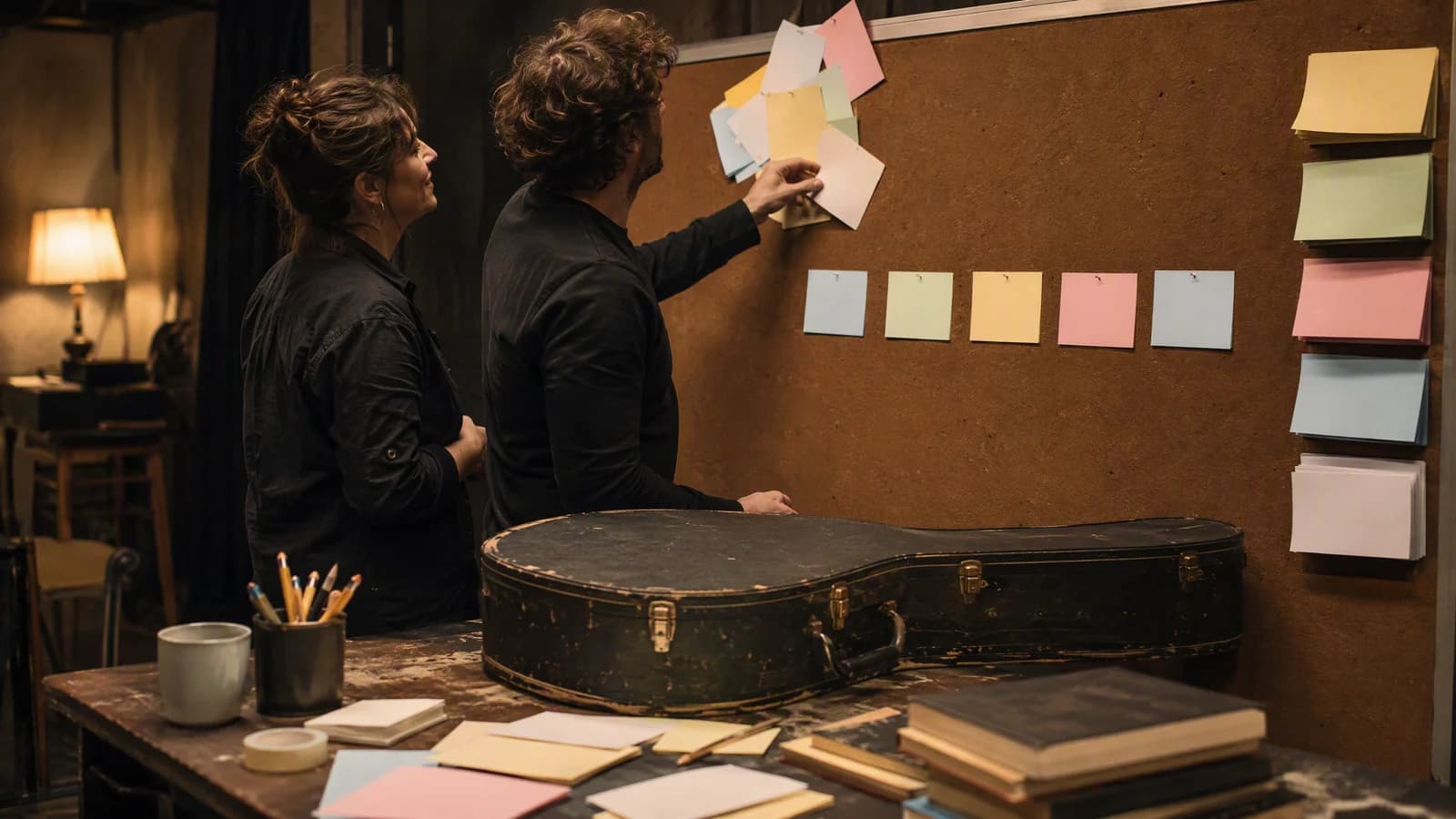
A feature idea walks into a short film and immediately bangs its head on the ceiling.
There are six main characters, three timelines, a childhood flashback, a car chase and a final image involving a trained wolf. The writer has twelve pages. The wolf has other commitments.
The answer is not to type smaller.
To write a short film script, build the story around one character making one consequential choice under immediate pressure. Enter close to the decisive moment, reveal character through visible behavior, let every scene change the situation and end after the choice creates a new emotional reality. Keep the cast, locations and production demands deliberate enough that somebody can imagine making the film—not merely admiring the PDF.
A short is not a feature screenplay on a crash diet. It is its own machine: fast to start, ruthless about dead weight and capable of leaving one image humming in the audience's head all the way home.
The short film script process at a glance
Here is the whole workflow before we pull it apart:
- Choose a moment of change, not a lifetime of events.
- Define the emotional before and after.
- Give the protagonist an urgent want and a difficult obstacle.
- Find the physical action that makes the conflict cinematic.
- Map five pressure beats from setup to consequence.
- Draft late into scenes and leave before the air goes out.
- Test every page for story value and production weight.
- Rewrite for clarity, compression and a final image that lands.
If you remember only one distinction, make it this: a short film can contain a large idea, but it usually needs a small container.
How long should a short film script be?
There is no single industry page count for every short. The destination matters.
Sundance Collab's January 2026 short screenplay course is designed around a completed screenplay of 5 to 15 pages. Film Independent's 2026 Project Involve criteria asked writer applicants for a complete short script of 10 pages or fewer, plus a separate 3-to-5-page prompt exercise. BFI NETWORK's 2026 short film funding program supported projects up to 15 minutes.
Those are program requirements, not laws of art. They do reveal something useful: five to fifteen pages is a practical working range for many narrative shorts, and a ten-page script can function as both a production blueprint and a writing sample. Always check the current rules of a particular fund, lab, contest or festival before submitting.
The old guideline that one screenplay page roughly equals one minute is a planning estimate, not a stopwatch. A page of rapid dialogue may fly. A page describing a long silent search may take much longer on screen. Once the draft exists, read it aloud, time the action honestly and—if you plan to direct—make a rough table read or animatic.
Do not begin by asking, “How do I fill ten pages?” Ask, “What is the shortest honest form of this change?”
1. Choose a pressure cooker, not a compressed epic
Weak short-film ideas often arrive as biographies:
A musician grows up poor, becomes famous, loses everything and reconciles with her daughter.
That may be a feature, a series or a heroic montage with suspiciously expensive music rights. It is not yet a short.
Find the moment when the life story becomes unavoidable:
Minutes before her estranged daughter's school recital, a broke former singer is offered cash to sell the guitar containing the only recording of the lullaby she wrote for her child.
Now the past, present and future collide in one pawnshop. The protagonist wants something concrete. Time is moving. A choice will reveal who she has become.
Use the pressure-cooker test:
- One container: What place, event, task or deadline naturally holds the action together?
- One urgent want: What does the protagonist need before the short ends?
- One resisting force: Who or what makes the obvious solution costly?
- One choice: What can the protagonist do that cannot be emotionally undone?
- One residue: What image or behavior shows the cost after the choice?
You can still imply a whole life. A call ignored, a worn uniform or a key that no longer fits can carry years of history. The short gets bigger when the details suggest a world beyond the frame—not when every year receives its own scene.
2. Define the emotional before and after
A short film does not require a twist. It does require a turn.
At the beginning, the protagonist believes, avoids or performs something. By the end, an event has made that position harder to maintain. The change can be triumphant, tragic, comic, terrifying or barely visible. It simply has to register.
Write these two lines before outlining:
Before: My protagonist behaves as if ______ because ______.
After: Because they choose to ______, they can no longer ______.
For our imaginary pawnshop short, Borrowed Song:
Before: Lena behaves as if the guitar is her last proof that she once mattered because facing her daughter feels riskier than preserving a memory.
After: Because she sells the guitar and keeps only the tiny recording hidden inside its case, she can no longer pretend the object is the relationship.
That is not a plot summary. It is the movement underneath the plot.
When a short feels “thin,” writers often add incidents. Try strengthening the before-and-after contrast first. If the opening and ending place the character in essentially the same emotional posture, another subplot will only give the sameness a hat.
3. Build one relationship that can generate friction
Two characters who agree about the situation are a support group. Two characters who need incompatible versions of the same moment are a scene.
The pawnshop owner could be a generic obstacle who offers too little money. More interesting: he recognizes Lena from her brief fame and wants the guitar as memorabilia. He values the identity she is trying to outgrow. She needs his money but hates the story that makes the object valuable.
Now every polite sentence has a second blade.
For each central character, write:
- what they want right now;
- what they think the scene is about;
- what leverage they hold;
- what truth they are avoiding; and
- what action would force the other person to reveal themselves.
Keep the cast small because concentration creates heat. This is not a commandment against ensembles. It is a warning that every additional speaking role asks for an entrance, a point of view, screen time, casting, scheduling and coverage on set. If two minor characters perform the same dramatic job, introduce them to each other and see whether they become one excellent character.
4. Turn the idea into visible behavior
“Lena realizes she has been hiding from motherhood” cannot be photographed.
Lena peeling an old backstage pass off the guitar case can.
Screenwriting becomes cinematic when internal pressure changes external behavior. Look for an object, task, ritual or spatial problem that lets the audience watch the argument.
Try the silent-version test. If the dialogue disappeared, what sequence of actions would still let us understand:
- who wants what;
- who currently has power;
- what changes;
- why the decision hurts; and
- how the ending differs from the beginning?
The BFI's short-film script editor Jessica Jones warns that writers often reach for more dialogue than they need and encourages visual ways to communicate character feeling (BFI writing guidance). That does not mean short films must be silent or that dialogue is a guilty pleasure. It means the words should complicate what the behavior already makes alive.
Our screenplay dialogue guide goes deeper on tactics and subtext. For a short, one ruthless pass is especially valuable: highlight every line that explains a feeling the actor could play or an object could reveal. Cut half of those lines. Then see whether the scene finally starts breathing.
5. Map five beats of escalating pressure
You do not need to squeeze a feature's three acts, midpoint and subplot machinery into ten pages. You need cause and effect.
Use this five-beat short film structure:
- Pattern: Show the protagonist's current strategy in motion.
- Intrusion: Introduce the problem that makes the strategy fail.
- Escalation: The protagonist acts, and the action increases the cost.
- Choice: They commit to a revealing action under maximum pressure.
- Afterimage: Show the new reality without explaining it to death.
Here is a possible ten-page map for Borrowed Song:
| Pages | Dramatic job | What changes |
|---|---|---|
| 1–2 | Pattern | Lena prepares to sell the guitar but secretly protects its battered case |
| 3–4 | Intrusion | The owner recognizes her and raises the offer if she proves it is authentic |
| 5–7 | Escalation | Playing the old lullaby could get the money, but it may make her miss the recital |
| 8–9 | Choice | She refuses the performance, sells the instrument cheaply and takes the hidden recording |
| 10 | Afterimage | At the school door, she deletes an old publicity photo before going inside |
The page ranges are provisional. The dramatic jobs are not.
Notice that the climax is not “Lena sells the guitar.” That was her plan on page one. The climax is how she sells it and which version of herself she refuses to perform. Plot delivers the choice; character gives it voltage.
If you prefer cards, our screenplay outlining guide shows how to build a chain of choices and consequences. For a short, keep the card count low enough that you can read the whole movie in one glance.

6. Enter each scene late—and make the exit do work
Short films are frequently murdered by greetings.
Characters enter, sit, ask whether they would like coffee, explain why they came and finally reach the subject everybody in the room already understands. Four minutes later, the audience has developed a rich inner life unrelated to your movie.
Start at the first moment the scene's outcome becomes uncertain.
Instead of opening with Lena walking to the pawnshop, checking the address and greeting the owner, begin with his hand already reaching for the guitar. She does not let go.
Instant relationship. Instant object. Instant question.
The Writers Guild Foundation argues that page one should introduce someone worth following, establish tone or thematic language and create anticipation (WGF Page One primer). In a ten-page short, page one is not a lobby. It is ten percent of the building.
End scenes with similar discipline. A strong exit may:
- answer the scene question in an unexpected way;
- transfer power;
- reveal that the character's tactic failed;
- force the next action; or
- leave an image whose meaning changes after the cut.
Do not stay for the emotional receipt. If Lena hears the offer, hides her reaction and opens the guitar case, cut before she says, “Fine. I will show you.” The action has already spoken.
7. Write for production without making the story timid
“Filmable” does not mean “two sad people in a beige room.” It means the screenplay understands what its images ask a production to do.
Every element carries story value and production weight. A rainstorm during the climax may be essential. A rainstorm in every exterior because rain looks cinematic may be your future producer quietly leaving the group chat.
Build a simple resource ledger:
| Element | Story value | Production weight | Keep, redesign or cut? |
|---|---|---|---|
| Second location | Gives Lena a reason to race | Company move, reset and schedule time | Redesign: hear the recital warming up by phone |
| Vintage guitar | Central choice object | Hero prop plus backup | Keep |
| Crowd of fans | Shows former fame | Extras, wardrobe, releases and coverage | Cut: owner recognition is more personal |
| Rain exterior | Adds melancholy | Weather control, sound and continuity | Cut unless it changes the decision |
This is not about estimating a budget from your desk with magical precision. It is about noticing expensive repetition, dependencies and logistics early enough to make creative choices.
Ask of every location, night exterior, vehicle, child performer, animal, crowd, stunt, special effect and copyrighted song:
- Does it change the story or merely decorate it?
- Can the same value come from a more specific human action?
- If it must remain, have I made it important enough to deserve the trouble?
Current short-film programs evaluate more than prose. The 2026 Sundance Ignite x Adobe Short Film Fund described its criteria in terms of artistic vision, storytelling, originality, feasibility and audience connection. That combination is the job: make something bold enough to matter and clear enough that collaborators can imagine finishing it.
Write the most exciting version of the right-sized idea. A perfect single location can feel enormous when power keeps changing hands.
8. Use screenplay format to disappear into the movie
A short film script uses standard screenplay format: scene headings, present-tense action, character cues, dialogue and transitions only when helpful. The short form does not unlock a special font or permit action paragraphs shaped like garden walls.
Keep action lines lean and playable. Describe what the audience can see or hear. Break paragraphs when the shot of attention changes—not every time you run out of horizontal space.
Badly compressed action:
Lena thinks about all the sacrifices she made, remembering the tour that destroyed her marriage and understanding that she has always chosen applause over intimacy.
Playable action:
The owner's phone finds an old photo: Lena onstage, guitar raised over a sea of hands.
She turns the screen facedown.
The second version does not dictate the actor's emotion. It gives the actor, director and editor behavior with which to build it.
Use our full screenplay format guide for margins, scene headings, dialogue, parentheticals and common spec-script questions. Then let formatting become invisible. Nobody leaves a great short whispering, “The margins experienced such growth.”
9. Rewrite the short in four separate passes
Trying to fix story, dialogue, logistics and commas simultaneously is how a writer spends six hours improving a line from a scene that should not exist.
Run four passes.
Pass one: the change
Read only for the protagonist's movement.
- Is the opening behavior specific?
- Does the obstacle attack that behavior?
- Does the climax require a choice rather than deliver an accident?
- Does the last image prove something changed?
Pass two: the pressure chain
Write one sentence beside every scene: “Because this happens, the protagonist does ______.” If the next scene could occur unchanged without the previous one, the chain has broken.
Pass three: the visible movie
Circle thoughts, explanations and backstory. Convert only what the audience needs into behavior, objects, sound, space or conflict. Do not translate every thought. Mystery is not a formatting error.
Pass four: the production draft test
List the cast, locations, day/night requirements, props, wardrobe changes, effects, music and special logistics. This is not a shooting schedule; it is a reality check. Make sure every heavy element earns a memorable beat.
The BFI's short-film guidance says recurring development notes include too many competing ideas, excessive dialogue, an unclear protagonist journey and ideas that do not land. It also makes the unglamorous case for redrafting before funding applications (BFI). Your first draft discovered the short. These passes make it communicable.
The ten-minute short screenplay stress test
Before sending the script out, answer these questions without explaining around them:
- Who wants what in the first page?
- What immediate pressure prevents delay?
- What does the protagonist do that makes the problem worse?
- Which beat could only happen in this short?
- What is the most important visible action?
- Where does power change hands?
- What does the climax force the protagonist to choose?
- What can be cut without changing the ending?
- Which production-heavy element earns its cost?
- What final image carries meaning that the opening image did not?
If three answers are vague, do not polish the dialogue. Return to the engine.
Common short film script mistakes
Writing the trailer for a feature
The short introduces a mythology, teases a villain and ends just as the actual conflict begins. Give this film its own dramatic question and consequence. “To be continued” is not emotional closure.
Confusing obscurity with depth
Withholding every motive does not automatically make a short mysterious. Let the audience understand the immediate want. Ambiguity becomes interesting after we have something solid to question.
Saving the movie for the twist
If the short is dull until the final reveal, the reveal is doing unpaid overtime. Make the minute-by-minute behavior engaging even if a viewer guesses the ending.
Explaining the last image
The character makes the choice, we see its consequence—and then two people discuss what it meant. Trust the image. End before the film applies for a permit to become a podcast.
Treating low budget as low imagination
Constraint can concentrate style. Sound, blocking, performance, color, repetition and point of view are cinematic tools. A hallway seen from the right moral angle can contain a universe.
Make the short prove what only you can do
A short screenplay can be a first produced film, a calling card, a lab sample, a proof of concept or simply the fastest way to discover whether an idea survives contact with actors, locations and an edit.
That makes the form small, not minor.
Write toward one decision you care about. Build pressure until the character cannot keep performing the old version of themselves. Let the production constraints sharpen the image instead of sanding away its personality. Then leave the audience with evidence, not an explanation.
Before asking collaborators, funders or a reader to invest in the film, make sure the script's structure, character agency and pacing are doing the same job. AI Script Coverage Pro can help you identify where a short stalls, repeats or reaches its climax without forcing a meaningful choice.
Create a free account, receive one welcome credit and use it for one free Quick Analysis. Ten pages leave nowhere for a soft scene to hide—and that is exactly why a short can make you a sharper screenwriter.
Sources
- Crafting Your Short Film Screenplay — Sundance CollabAccessed 2026-08-13
- Writing Tips From the Top — British Film InstituteAccessed 2026-08-13
- Project Involve 2026 Application Sample and Essay Criteria — Film IndependentAccessed 2026-08-13
- Writing Your Screenplay: Page One — Writers Guild FoundationAccessed 2026-08-13
- BFI NETWORK England Short Film Funding — British Film InstituteAccessed 2026-08-13
- 2026 Sundance Institute Ignite x Adobe Short Film Fund — Sundance InstituteAccessed 2026-08-13