Screenwriting Craft · guide
How to Write a TV Pilot That Promises a Whole Series
Learn how to write a TV pilot with a repeatable story engine, compelling ensemble, strong episode arc, original examples, and a practical rewrite test.
A feature screenplay asks, “Was that a movie?” A TV pilot has to survive a more devious question:
“Would I watch another one?”
That is why a pilot can contain sharp dialogue, a terrific lead and a third-act fireball—and still feel like a movie wearing a name tag that says television. The episode may work. The series has not introduced itself.
To write a TV pilot, create one urgent episode story that reveals a repeatable source of future conflict. Introduce the protagonist and ensemble through consequential choices, demonstrate the show’s tone and episode pattern, resolve enough to satisfy the audience, then leave relationships, goals or consequences capable of generating another episode.
The pilot is not a trailer for the good show you plan to write later. It is the first working example of that show.
The TV pilot’s double job
Every original pilot is selling two pleasures at once:
- The pleasure of this episode: a problem begins, escalates and produces a meaningful outcome.
- The pleasure of the series: the outcome creates or exposes a durable reason these characters will keep colliding.
Call the second pleasure the story engine. It is not simply the setting. “A restaurant” is a location. “An obsessive chef must keep a failing family restaurant alive while managing relatives who disagree about what the place should become” is an engine. It contains desire, pressure, relationships and a renewable supply of bad Tuesdays.
This distinction matters beyond theory. The current Disney Entertainment Television Writing Program asks applicants for two pre-existing original pilots that capture the writer’s tone, style and point of view; writers selected for the program develop and polish another original pilot as a staffing sample. A professional sample is therefore proving more than your ability to arrange scenes. It is showing what kind of television writer you are.
Before opening your screenwriting software, write these two sentences:
In the pilot, the protagonist must ______ before ______.
In the series, the protagonist repeatedly must ______ while ______.
If the second blank produces only “deal with life,” the engine needs fuel.
The pilot process at a glance
Here is the whole workflow before we take it apart:
- Define the show’s repeatable promise.
- Choose a pilot problem that forces the series to begin.
- Give the protagonist a costly decision, not a guided tour.
- Build the ensemble as a system of incompatible needs.
- Track a clear A story and only the supporting stories you can land.
- Open on the show’s specific voice or pressure.
- Escalate through choices and consequences.
- Resolve the episode while opening the series.
- Rewrite for pace, character distinction and proof of engine.
The Sundance Collab pilot course similarly frames pilot development around outline, pace and story engine. That order is useful: establish what keeps producing stories, then decide how this first story moves.
1. Define the repeatable promise
Imagine an original one-hour dramedy called Last Stop. Mara, a brilliant city-bus mechanic, is promoted to manage the night depot after exposing a safety cover-up. The promotion saves her job and makes her responsible for the same chaotic crew that helped her uncover it.
The premise contains several ingredients. The promise tells us what we will repeatedly watch:
Each episode, Mara must keep the city’s night buses moving while solving a human or mechanical crisis that tests her uneasy authority over the depot crew.
Now we can picture episode two. A heat wave knocks out air conditioning across the fleet. A driver refuses an unsafe vehicle. Mara’s former boss quietly undermines her repair plan. The engine starts without the pilot’s cover-up happening again.
Use this promise test:
- Arena: Where does the show naturally gather its characters?
- Activity: What do they repeatedly do that can be filmed?
- Pressure: Why is that activity difficult every week?
- Relationship system: Why can these people neither cooperate peacefully nor simply walk away?
- Variation: What changes from episode to episode?
- Continuity: What emotional or serial problem keeps accumulating?
A premise becomes a series when repetition creates variation instead of sameness.
2. Choose the event that makes episode two possible
Many weak pilots explain the normal world for forty pages and change it near the end. That is a museum tour followed by an earthquake.
Start the series earlier.
The pilot event should force a new arrangement the show can continue exploring. Mara exposes the cover-up, but the more important consequence is her promotion. She gains authority over people who still remember her borrowing tools and complaining about management. The victory manufactures the series conflict.
Ask three questions about your inciting event:
- What becomes impossible to return to?
- Which characters are newly trapped together, separated or placed in conflict?
- What recurring obligation begins because of this event?
The pilot problem and the series engine should touch. They do not have to be identical. In fact, they usually should not be. If every episode requires another conspiracy as large as the pilot’s, your show has promised itself a nervous breakdown.
3. Introduce the protagonist through a decision
Character biography is invisible. Choice photographs beautifully.
Do not introduce Mara with coworkers listing her qualities while she fixes something impressive in the background. Give her a decision that makes her values expensive. She can sign off on a questionable bus and protect the night schedule, or pull it from service and leave hundreds of riders stranded. Either answer costs her.
That single choice can reveal:
- expertise;
- moral line;
- tactical style;
- relationship to authority;
- blind spot; and
- the kind of trouble the series will keep finding.
Your lead does not need to be likable in the first five pages. The lead needs to be legible: pursuing something, making judgments and affecting the world.
Try the pilot-pressure sentence:
When [specific disruption] threatens [immediate goal], my protagonist chooses to [risky action], which reveals [defining value or flaw] and creates [series consequence].
That is far more useful than three pages about childhood fears and favorite breakfast cereal.
4. Build the ensemble as a conflict machine
An ensemble is not a row of colorful headshots. It is a network of unfinished arguments.
For each important character, define what they want from the protagonist and why giving it to them would damage another relationship. Mara’s veteran foreman wants freedom from paperwork. The youngest mechanic wants formal training. The operations director wants buses out on time regardless of shop politics. A union representative wants every shortcut documented.
Nobody needs to be the villain. They need incompatible definitions of success.
Use a relationship grid:
| Character | Wants from the lead | Leverage | Recurring collision |
|---|---|---|---|
| Veteran foreman | Trust without supervision | Crew loyalty | Experience versus accountability |
| Apprentice | Mentorship and a real chance | Sees what others overlook | Growth versus limited time |
| Operations director | A clean performance record | Controls budget and schedules | Speed versus safety |
| Union representative | Transparent decisions | Can stop the shop | Protection versus flexibility |
The goal is not to explain every relationship in the pilot. It is to make each featured relationship produce a specific kind of friction. A viewer should finish the episode imagining at least two characters they want trapped in a room together next week.
5. Give the episode a spine before adding side stories
TV writers often speak in A, B and C stories, but letters do not create hierarchy. Consequences do.
The A story is usually the episode’s main dramatic question. Can Mara diagnose the failure and stop the unsafe bus before departure? A B story might follow the apprentice hiding a mistake that contributed to the problem. A smaller story could reveal the foreman preparing to transfer out rather than work for Mara.
Each supporting story should do at least one of three jobs:
- complicate the A story;
- reveal another face of the episode’s theme; or
- advance a relationship that powers the series.
If a subplot merely gives a charming character something to do, it may belong in the imaginary DVD extra titled “Scenes We Loved More Than the Pilot Did.”
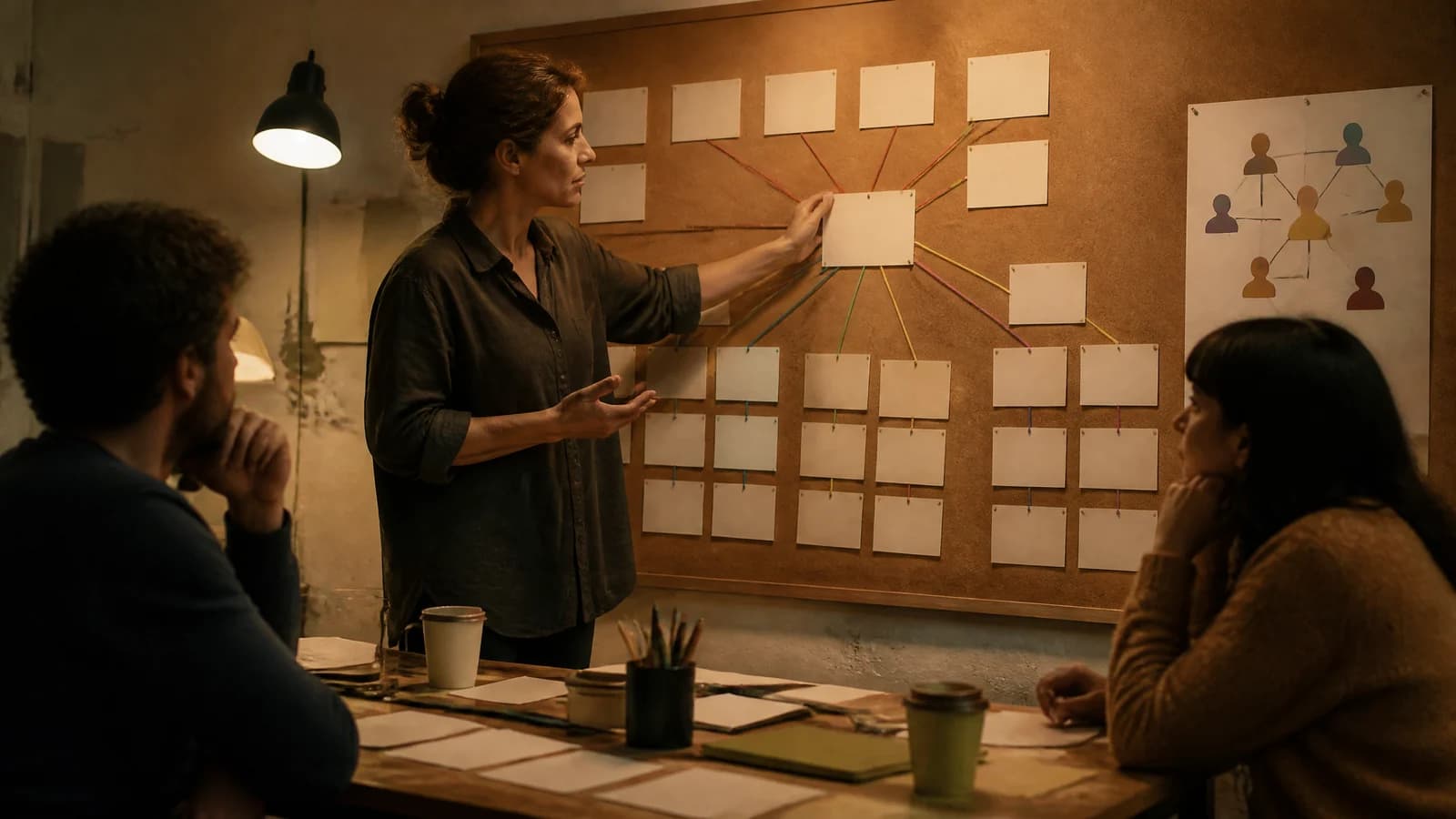
Outline the A story first as a cause-and-effect chain. Our screenplay outlining guide shows how to build major beats from decisions rather than calendar events. Then add supporting stories where their turns apply pressure, create contrast or steal a resource the A story needs.

6. Structure the pilot around pressure, not inherited act numbers
There is no universal pilot beat sheet. A broadcast drama, a streaming comedy and a public-service broadcaster’s limited series may use different act patterns, lengths and interruption rhythms. The current destination’s rules outrank a diagram found in a screenwriting book.
What every pilot does need is movement. Try mapping sequences by pressure:
- Demonstrate the old pattern. Show the lead operating before the series arrangement fully locks into place.
- Disrupt it. Introduce the problem that cannot be handled by routine.
- Force commitment. The lead makes a choice that closes an easier escape.
- Make the strategy fail. Success becomes more expensive or personally dangerous.
- Collide the stories. Supporting conflicts alter the main problem.
- Demand the defining choice. The lead acts in a way only this character would.
- Pay off the episode. Answer the immediate dramatic question.
- Reveal the new pattern. Show the arrangement, cost or question that can power what follows.
If your intended outlet or submission format uses labeled acts, format them correctly. The BBC’s TV screenplay format guide demonstrates teasers and act breaks while also emphasizing the basics: scene headings identify place and time, action describes what can happen on screen, and spec scripts omit production clutter such as scene numbers.
Formatting is delivery infrastructure. It should help the reader experience the episode, not become the episode’s most memorable character. See our full screenplay format guide for the underlying page mechanics.
7. Make the first pages sound like this show
“Start with something exciting” is incomplete advice. A meteor strike is exciting. It is also a strange opening for your intimate divorce comedy unless the meteor gets joint custody.
Open on a source of pleasure or pressure the series actually intends to repeat:
- the job being performed under unusual strain;
- the central relationship playing its favorite dangerous game;
- the lead’s worldview producing a clever solution and a fresh problem;
- a tonal collision only this show would attempt; or
- a mystery whose pursuit belongs to the series, not just the pilot.
The Writers Guild Foundation’s fellowship guidance urges writers to hook readers in the first few pages, take a real creative risk and prioritize compelling story and character voice over formatting obsession. That does not mean detonating the plot on page one. It means making the reader feel the writer’s command early.
For Last Stop, an opening bus failure could be generic. A better opening lets Mara identify a dangerous vibration by listening through the handle of a stolen mop while dispatch pressures her to release the vehicle. Now the crisis, workplace, competence, humor and institutional conflict arrive in the same scene.
The opening has made a promise. The rest of the pilot must keep it.
8. End the episode and begin the series
A pilot ending should close one door loudly enough that we hear three others unlock.
Resolve the question you asked. If the episode is about stopping an unsafe bus, decide whether Mara succeeds and what it costs. Do not mistake withholding the entire ending for sophistication. A viewer who receives no payoff may not feel curious; they may feel invoiced.
Then expose the durable consequence:
- success creates a new obligation;
- a repaired relationship adopts a more complicated shape;
- the protagonist gets the thing they wanted and discovers its true price;
- a contained mystery reveals a larger pattern; or
- the ensemble accepts a mission while disagreeing about how to pursue it.
Mara stops the bus and proves the cover-up. The director fires her boss and offers Mara the job. She accepts. Then she walks onto the shop floor and sees the crew waiting—not applauding. The apprentice asks which bus gets fixed first.
Episode question answered. Series question activated.
9. Read pilots like a television mechanic
Do not study only the shows that resemble your idea on the surface. Read pilots that solve the same structural problem.
If you are writing a workplace ensemble, study how several pilots introduce hierarchy. If the show has a mystery engine, compare how pilots distinguish the episode answer from the series question. If your comedy depends on a volatile pair, track how quickly each pilot creates a repeatable relationship pattern.
The Writers Guild Foundation’s online script resource guide notes that pilots are among the television scripts most commonly available online and warns writers to distinguish actual scripts from transcripts. That distinction matters. A transcript shows what was said in the finished episode. A script shows what the reader encountered on the page.
For each pilot you read, make a one-page reverse outline:
- What does the opening promise?
- When does the series arrangement become inevitable?
- What is the A-story question?
- How is each major character introduced through action?
- Where does the lead make the defining choice?
- What resolves?
- What can repeat?
Three reverse outlines will teach you more than tracing one fashionable beat sheet until your own show disappears underneath it.
10. Rewrite the pilot as a sample of you
A pilot can prove the show works and still undersell the writer.
On the rewrite, identify the scenes another competent writer could execute almost exactly the same way. Those are your generic pressure points. The solution is not to make every line eccentric. It is to bring your specific observations, comic timing, moral tension and relationship instincts closer to the surface.
Run five focused passes:
Pass 1: engine
Highlight moments that demonstrate what episodes will repeatedly do. If the engine exists only in your pitch document, put it into action.
Pass 2: protagonist
Circle every consequential choice. If other characters keep moving the lead into position, return the steering wheel.
Pass 3: ensemble
Write the recurring conflict beside each major relationship. Merge or cut characters who perform the same dramatic job.
Pass 4: pace
Track entrances, decisions, reversals and exits. Cut setup the audience can infer and repeated information they already survived once. The principles in our screenplay dialogue guide can help turn exposition into leverage instead of a briefing.
Pass 5: promise
Compare the first five pages with the final five. Do they belong to the same show? Does the ending deliver a new version of the pressure, relationship or pleasure introduced at the start?
A copyable TV pilot worksheet
Complete this without using “interesting,” “complex” or “unique.” Make the nouns and verbs prove those adjectives.
| Pilot question | Your answer |
|---|---|
| What repeatable experience does the show promise? | |
| What does the protagonist do in a typical episode? | |
| Why can the central characters not simply separate? | |
| What changes from episode to episode? | |
| What accumulates across the series? | |
| What urgent problem drives the pilot? | |
| Which decision makes the series arrangement inevitable? | |
| What does the episode resolve? | |
| What future conflict does the ending activate? | |
| What in the first five pages could only belong to this show? |
If the first five answers describe a world but no recurring action, the show may still be a premise. If the final five describe only setup for later, the pilot may still be a prologue.
Common TV pilot mistakes
The encyclopedia opening
The pilot explains the institution, mythology and family history before anyone wants anything. Introduce information when it changes a decision.
The guest-star protagonist
The lead watches more active characters launch the series. Give the protagonist a choice that creates the new arrangement.
The disposable pilot villain
Every conflict attaches to one antagonist who exits forever at the end. Let the villain expose a durable disagreement inside the ensemble or institution.
The episode-two alibi
Whenever a missing pleasure is identified, the writer says, “That starts next episode.” Put a working version of the show in the pilot.
The subplot buffet
Every character receives a story, so none has time to turn. Prioritize the episode spine and the relationships that prove the engine.
The cliffhanger trapdoor
The pilot refuses to answer its main question, then calls the absence a hook. Give the audience satisfaction and curiosity, not a hostage negotiation.
Frequently asked questions about TV pilots
How long should a TV pilot be?
There is no single page count for every TV pilot. Length varies by intended format, genre, outlet and submission rules. Read produced pilots in your lane, use standard screenwriting format and check the current requirements of any program or buyer before submitting. “Half-hour” and “hour-long” describe programming categories, not permission to pad toward a magic number.
Does a TV pilot need act breaks?
Only when the target format or submission rules require them. Broadcast structures may use explicit act breaks; other scripts may not. Even without labels, the story still needs escalating turns and sequence-level movement.
Do I need a series bible before writing the pilot?
Not necessarily. A compact private document covering the premise, characters, engine and several future episode ideas can help you test the series. Create a formal bible or pitch deck when a specific opportunity requests one. Do not use extra documents to postpone solving the pilot.
What is the difference between an original pilot and a spec episode?
An original pilot launches a series you created. A spec episode is an unofficial sample episode of an existing show, written to demonstrate your ability to match its voice and structure. Current application requirements vary; for example, Disney’s 2027 program required two original pilots.
Should the pilot explain the whole first season?
No. It should make the season feel possible. Establish the central engine, relationships and major pressure without turning characters into announcers for episodes that do not exist yet.
Make the reader want episode two
The final test is brutally simple: after the last page, can a reader imagine another episode—and do they want it?
Not another escalation of the same pilot plot. Another fresh problem produced by the same engine. Another collision between people whose needs cannot remain politely separated. Another hour or half-hour that delivers the pleasure your opening promised.
Before submitting, use the logline test to make the series promise concrete, then ask an outside reader to describe the show they believe they just read. If their answer names only the pilot crisis, the episode may work while the engine remains hidden.
AI Script Coverage Pro can help you examine whether the protagonist drives the pilot, the ensemble has distinct functions, supporting stories connect to the spine and the ending opens a repeatable dramatic future. It cannot invent your point of view. That is the part the pilot is supposed to prove.
Create a free account, receive one welcome credit and use it for one free Quick Analysis. Find the scene where your series truly begins, move it closer, and make episode one feel like the first irresistible example—not the instruction manual.
Sources
- 2027 Disney Entertainment Television Writing Program Application — Disney Entertainment Television Creative Talent Development & InclusionAccessed 2026-08-09
- Where to Read Film and TV Scripts Online — Writers Guild FoundationAccessed 2026-08-09
- 10 Tips for Fellowship Applications — Writers Guild FoundationAccessed 2026-08-09
- Screenplay Format for TV Shows — BBC WritersroomAccessed 2026-08-09
- TV Writing: From Outline to First Draft of Your Pilot — Sundance CollabAccessed 2026-08-09